
Baby Acne: What It Is and What to Do
Those tiny red or white bumps on your newborn’s cheeks can be surprising — you expected soft, flawless baby skin, not pimples. Baby acne is one of the most common skin concerns in the first weeks of life, and it worries far more parents than it harms babies.
The reassuring truth: baby acne is harmless, painless, and almost always temporary. It usually clears up on its own without any treatment. What matters most is resisting the urge to “fix” it — most of the harm from baby acne comes from well-meaning treatments, not from the bumps themselves.
What Is Baby Acne?
Baby acne (also called neonatal acne) looks like small red bumps or whiteheads, usually on the cheeks, nose, forehead, or chin. It typically appears in the first 2 to 4 weeks of life and affects roughly 20 percent of newborns.
Unlike teenage acne, baby acne is not caused by poor hygiene or anything you did. It happens because maternal hormones, which pass to the baby before birth, stimulate the baby’s oil glands for a short time. As those hormones leave the baby’s system, the acne fades.
Baby acne is different from a few look-alike conditions:
- Milia: Tiny white bumps, usually on the nose, that are trapped skin flakes — not acne.
- Erythema toxicum: A red, blotchy newborn rash with small bumps that comes and goes in the first days of life.
- Eczema: Dry, scaly, itchy patches that tend to appear after the first month or two and need different care.
If you are unsure which one your baby has, a quick check with your pediatrician can settle it.
What Causes Baby Acne?
The main cause is hormones. During pregnancy, maternal hormones cross the placenta and linger in the baby’s body for a few weeks after birth. These hormones temporarily activate the baby’s sebaceous (oil) glands, especially on the face — and the result is baby acne.
A few things can make it look worse temporarily:
- Crying or fussing: Increased blood flow can make the bumps redder for a short time.
- Heat or spit-up: Warmth and milk residue on the skin can irritate the bumps.
- Rough fabrics: Scratchy blankets, clothing, or bedding rubbing against the face.
- Oily products: Lotions, oils, or creams applied to the face can clog the tiny pores further.
None of these cause the acne, but keeping them in check can keep it from looking more dramatic than it is.
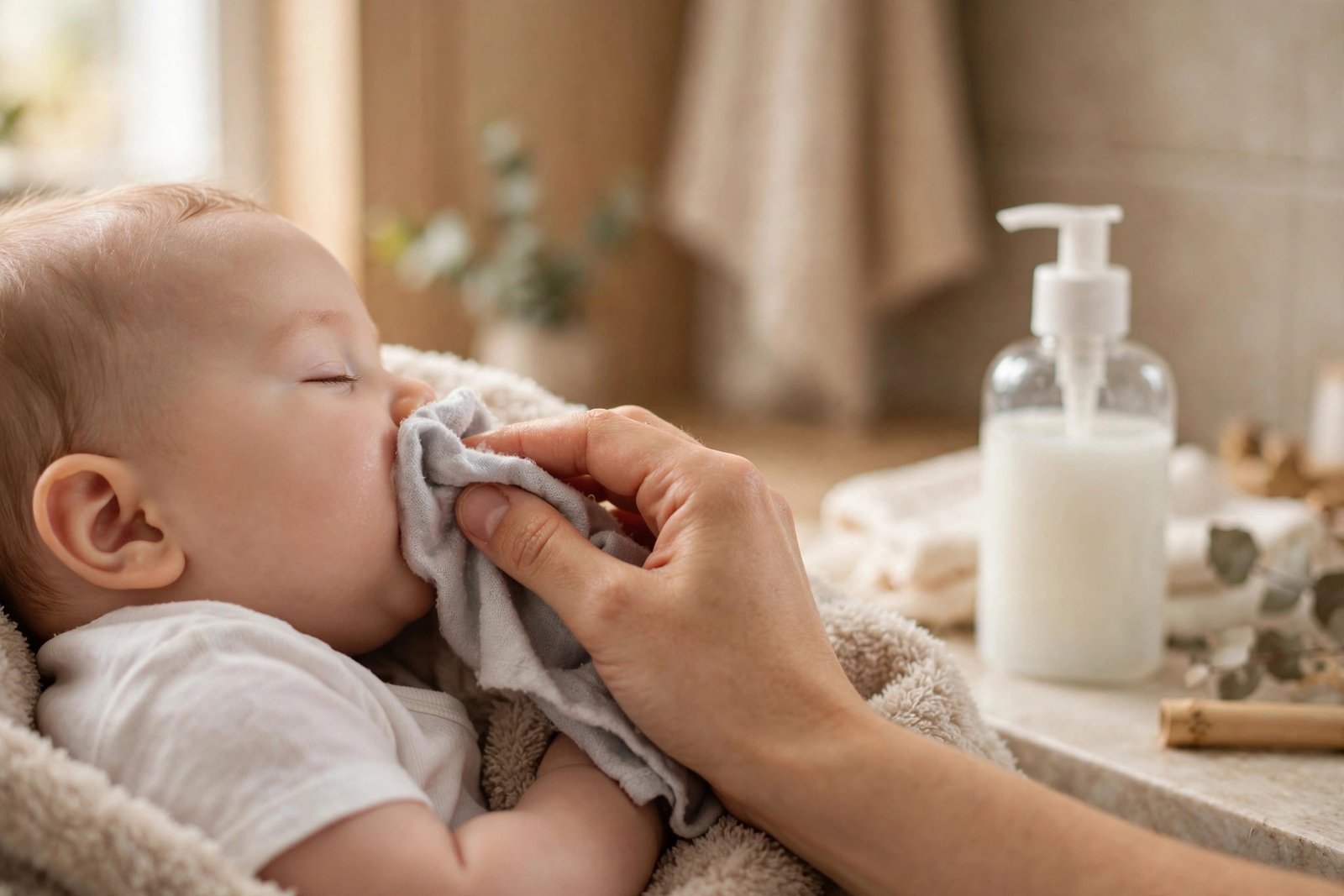
What to Do About Baby Acne
For most babies, the answer is: very little. Baby acne typically clears on its own within a few weeks to a couple of months, without leaving marks. Gentle, hands-off care is the safest approach.
1. Keep the face clean — gently
Wash your baby’s face once a day with lukewarm water and a soft cloth. If you want to use a cleanser, choose a mild, fragrance-free baby wash and rinse well. Pat dry — never rub.
2. Keep milk and spit-up off the skin
After feeds, gently wipe any milk or spit-up from the face with a damp cloth. Dried milk residue can irritate the bumps and make them look worse.
3. Use soft fabrics
Choose soft cotton clothing and bedding. Wash new items before use with a gentle, fragrance-free detergent, since residues from regular detergents can irritate newborn skin.
4. Keep the face product-free
Skip lotions, oils, and creams on the face unless your pediatrician recommends one. Baby acne does not need moisturizer, and oily products can make it worse.
5. Be patient
This is the hardest part. Baby acne almost always resolves on its own. Watching and waiting is not neglect — it is the medically recommended approach.
What NOT to Do
This section matters more than the last one. Many parents accidentally make baby acne worse by trying to treat it like adult acne.
- Do not use acne products. Adult or teen acne treatments — benzoyl peroxide, salicylic acid, retinoids — are far too harsh for newborn skin and can cause serious irritation or chemical burns.
- Do not scrub or exfoliate. Rubbing the bumps will not clear them faster. It damages the delicate skin barrier and can lead to soreness or infection.
- Do not pick or squeeze. Picking at baby acne risks scarring and infection, and it does nothing to speed healing.
- Do not apply home remedies. Steroid creams, essential oils, coconut oil, breast milk, or herbal pastes on the face can irritate newborn skin or introduce infection. What works for adult skin is not automatically safe for babies.
- Do not over-bathe. Extra baths dry out the skin and will not clear the acne any faster. Stick to your normal bathing routine.
If anyone — a relative, a friend, a well-meaning stranger — urges you to “do something” about the bumps, you can confidently say your pediatrician’s advice is to leave them alone.
When to See a Doctor
Baby acne is almost always harmless, but check in with your pediatrician if:
- The acne appears after 6 weeks of age (this may be a different condition sometimes called infantile acne).
- There are blackheads, deep lumps, or cysts — these are unusual in newborn acne.
- The bumps spread to the body, not just the face.
- The skin looks infected: spreading redness, warmth, swelling, yellow crusts, or pus.
- Your baby seems uncomfortable, is feeding poorly, or has a fever along with the rash.
- The acne has not improved at all after 3 months.
Infantile acne (starting later, around 3 to 6 months) is less common and sometimes needs medical treatment, so it is worth having your doctor take a look if the timing does not match classic baby acne.
Frequently Asked Questions
How long does baby acne last?
Most cases clear within a few weeks to 3 months. It fades gradually as maternal hormones leave the baby’s system. No treatment speeds this up safely.
Is baby acne painful or itchy?
No. Baby acne does not bother the baby at all — it bothers the parents. If your baby seems itchy or uncomfortable, the rash may be something else, like eczema, and is worth checking.
Can breastfeeding cause baby acne?
No. Baby acne is caused by hormones transferred before birth, not by breast milk. You do not need to change your diet or stop breastfeeding.
Should I put lotion on baby acne?
No. Moisturizers and oils can clog the tiny pores and make baby acne worse. Keep the face clean and product-free unless your pediatrician advises otherwise.
Will baby acne leave scars?
Almost never. Baby acne clears without marks when left alone. Scarring is really only a risk if the bumps are picked, squeezed, or treated with harsh products.
Does baby acne mean my child will have acne as a teenager?
Not necessarily. Baby acne and teenage acne are different conditions with different causes. Having baby acne does not predict teenage breakouts.
The Bottom Line for Parents
Baby acne is common, harmless, and temporary. It needs no treatment — just gentle daily cleansing, soft fabrics, and the discipline to leave it alone. The bumps will fade on their own within weeks to a few months, leaving no trace.
The hardest part is doing nothing, but in this case, nothing is exactly the right thing. With a little patience, your baby’s skin will clear up all by itself.
Related reading: How to Clean Your Baby’s Face Daily, Skincare Ingredients to Avoid for Children, and When Do Babies Outgrow Dry, Flaky Skin?.
*This article is for informational purposes only and is not medical advice. If you are concerned about your baby’s skin, consult your pediatrician.*
—
Publish spec (for main agent): Title as above. Focus keyword: baby acne. Internal links: 3 as in Related reading. 1 Merriam-Webster dictionary link in conclusion’s last 3 lines (patience). Realistic featured image 1200×800, Title=slug, Alt=focus keyword, 2 content images, meta description as in frontmatter.
