
Babies can wear sunscreen from 6 months old, applied regularly to exposed skin. Under 6 months, pediatric guidance says to keep babies out of direct sunlight instead — using shade and protective clothing — with sunscreen only on tiny areas like the face if shade truly isn’t available. Here’s the full picture, straight from pediatric guidance.
It’s one of the most common summer questions new parents ask, and the answer has a clear, simple rule behind it.
The 6-Month Rule, Explained
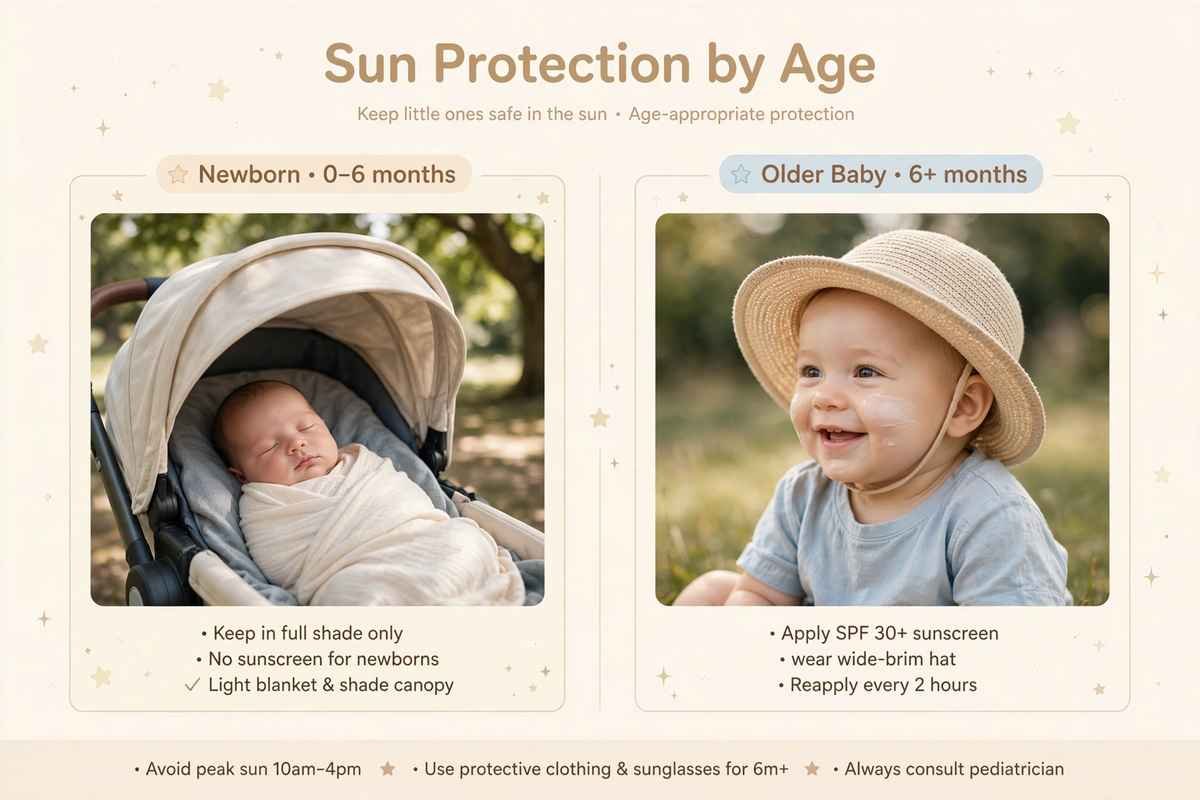
The American Academy of Pediatrics recommends keeping babies younger than 6 months out of direct sunlight. Their skin is thinner, more delicate, and more vulnerable to both sunburn and the potential side effects of sunscreen ingredients. That’s why the first line of defense for young babies isn’t a product — it’s shade.
The exception: if protective clothing and shade genuinely aren’t available, the AAP’s sun safety guidance says sunscreen may be used on small areas of the body, such as the face and the backs of the hands. Think of it as a backup plan, not the routine.
From 6 months on, sunscreen becomes a regular part of going outside — applied to all exposed areas, reapplied through the day.
Sun Protection by Age: At a Glance
| Age | Main protection | Sunscreen role |
|---|---|---|
| 0–6 months | Shade, lightweight long clothing, wide-brimmed hat; avoid 10am–4pm sun | Only on small areas (face, backs of hands) if shade/clothing unavailable |
| 6–12 months | Shade + clothing + hat, plus sunscreen | Broad-spectrum SPF 30+, all exposed skin |
| Toddlers & kids | Same layered approach | SPF 30+, reapply every 2 hours and after swimming |
What to Do Instead for Babies Under 6 Months
Keeping a tiny baby sun-safe without sunscreen is very doable:
- Seek real shade. Under a tree, a beach umbrella, a pop-up tent, or a stroller canopy with UV protection. Remember that shade alone isn’t perfect — UV reflects off sand, water, and concrete.
- Dress them for it. Lightweight long sleeves and long pants in tightly woven fabric, plus a wide-brimmed hat that shades the neck and ears (baseball caps leave too much exposed).
- Time outings wisely. Avoid the strongest sun between 10 a.m. and 4 p.m. Morning and late-afternoon strolls are kinder.
- Check with your pediatrician before using any sunscreen on a baby under 6 months — the AAP’s baby sunburn prevention tips reinforce that shade and clothing come first at this age.
Choosing Sunscreen from 6 Months On
Once your baby hits 6 months, here’s what pediatric and dermatology guidance points to:
- Broad-spectrum, SPF 30 or higher. Higher SPFs offer only marginally more protection — SPF 30 blocks about 97% of UVB rays — so don’t chase extreme numbers.
- Mineral (zinc oxide / titanium dioxide) formulas are often recommended for young children because they sit on the skin’s surface and tend to be gentler on sensitive skin. The AAD’s infant sun protection page notes mineral options for babies when shade isn’t available.
- Water-resistant if there’s any chance of water play or heavy sweating — but remember no sunscreen is truly waterproof, so reapplication is non-negotiable.
- Fragrance-free is a smart default for children’s skin, just as with moisturizers (see our guide on when kids should start using moisturizer).
How to Apply It Right (This Matters as Much as the Product)
Most people use far too little sunscreen — and kids are no exception:
1. Apply 15–30 minutes before going out, so it has time to form its protective layer.
2. Be generous. A good rule of thumb: about a teaspoon per limb, a teaspoon for the back
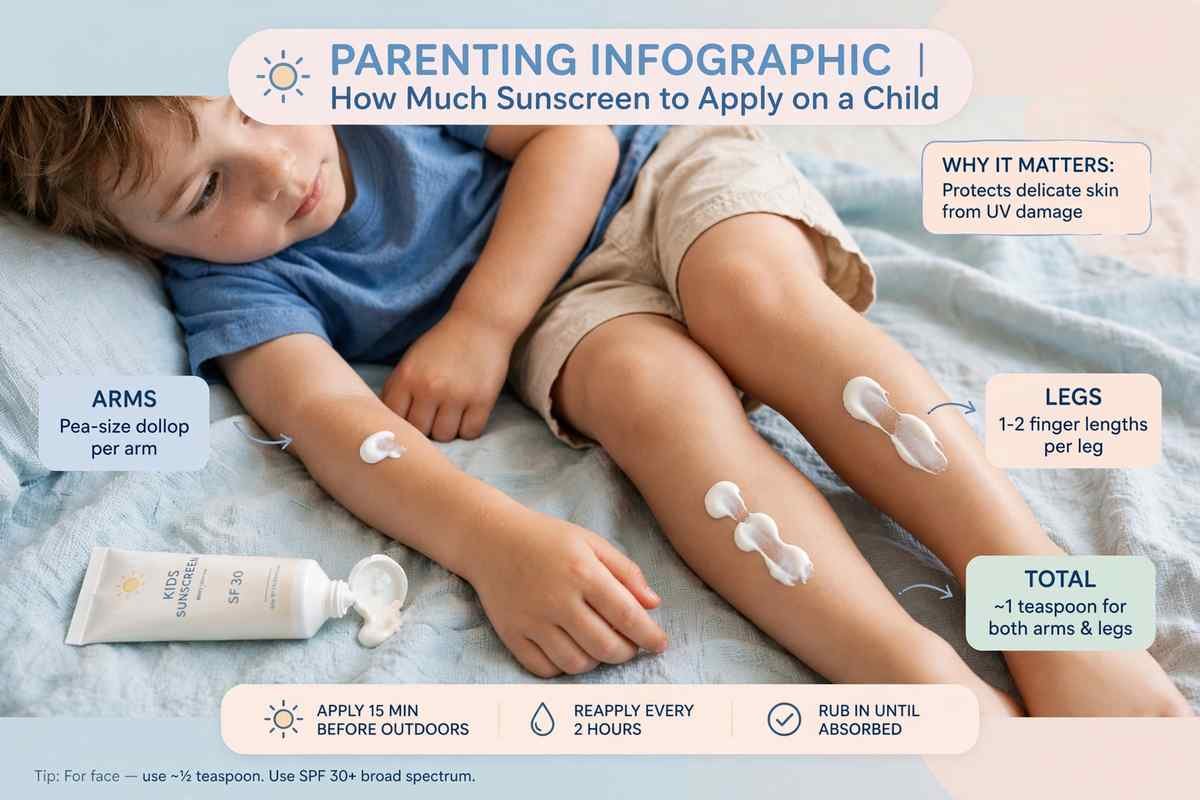
, a teaspoon for the chest, and half a teaspoon for the face and neck.
3. Don’t forget the easy-to-miss spots: ears, back of the neck, tops of feet, and around swimsuit edges. For faces, our baby face-cleaning guide shows how delicate that skin is — apply sunscreen there gently and keep it away from eyes.
4. Reapply every 2 hours, and immediately after swimming, sweating heavily, or toweling off.
5. After a swim day, rinse off with fresh water and moisturize — our baby bathing guide explains how bath routines fit around active, outdoorsy days.
Sunscreen Mistakes Parents Make
Even careful parents get tripped up by these:
- Applying it at the beach, not before. Sunscreen needs 15–30 minutes to form its protective layer. Apply at home, before shoes go on.
- Using last year’s bottle without checking. Sunscreen expires — check the date. An expired bottle may offer far less protection than the label promises.
- Missing the ears and neck. These burn fast and hurt a lot. Make them part of your mental checklist every time.
- Skipping reapplication after the paddling pool. “Water-resistant” means it survives some water exposure, not a whole afternoon of splashing. Reapply after every swim.
- Relying on sunscreen alone for babies. For under-6-month-olds especially, sunscreen is the backup — shade and clothing are the plan. Even for older kids, layering all three gives the best protection.
When to See Your Pediatrician
Call your pediatrician right away if:
- A baby under 12 months gets any sunburn — the AAP treats infant sunburn seriously
- An older child has blistering, pain, or fever with a sunburn
- Your baby develops a rash after trying a sunscreen (try a different mineral formula, and mention it to your doctor)
- You’re unsure about sun protection for a baby with very fair or very sensitive skin
FAQ
Can I use my adult sunscreen on my baby?
For babies over 6 months, an adult mineral sunscreen (zinc oxide/titanium dioxide, SPF 30+, fragrance-free) is generally fine — the formulas aren’t fundamentally different. What’s made “for kids” is mostly about gentler ingredients and easier application. Under 6 months, the shade-first rule still applies regardless of product.
Is spray sunscreen safe for toddlers?
Sprays are convenient but easy to apply too thinly, and the mist can be inhaled. If you use one, spray it into your hands first and rub it on — never spray directly toward the face.
Do babies need sunscreen on cloudy days?
Yes. Up to 80% of UV rays penetrate cloud cover, and babies can burn on overcast days without anyone noticing until later. If they’re outside for a while, protect them the same as on sunny days.
What about sunscreen and vitamin D?
Brief, sensible sun protection doesn’t meaningfully harm vitamin D levels in children — pediatric guidance is clear that sun safety comes first, and vitamin D needs are easily met through diet and supplements if your pediatrician recommends them.
My baby rubbed sunscreen in their eyes — what do I do?
Wipe eyes and hands gently with a damp cloth. Tearfulness and redness usually settle quickly. If irritation persists or your baby seems very uncomfortable, call your pediatrician.
Keep Reading
You may also like: Mineral vs Chemical Sunscreen for Kids Is Spray Sunscreen Safe for Toddlers? How Often to Reapply Sunscreen on Kids What SPF Should Kids Use? Sunscreen for Babies Under 6 Months: A Parent’s Guide How to Get a Toddler to Wear Sunscreen Do Kids Need Sunscreen in Winter? A Parent’s Guide Kids’ Daily Skincare Routine by Age Do Tweens Need Serums? A Parent’s Guide Sunscreen for Kids: The Complete Parent’s Guide Toddler Skincare Routine: A Simple Guide
This article is for general information only and is not medical advice. Every child’s skin is different — if you’re unsure or notice anything concerning, talk to your pediatrician or a dermatologist.

Jessica covers kids’ health and skincare topics for parents. Her articles break down expert recommendations into clear, everyday advice — always with a reminder that your pediatrician knows your child best.