
Waking up with a shiny forehead or noticing that your face looks greasy only a few hours after washing can be frustrating. If you’re constantly reaching for tissues or blotting papers, you may wonder how to reduce oily face problems without making your skin dry, tight, or irritated.
The good news is that you don’t need to strip all the oil from your skin. Sebum, the natural oil produced by your skin, helps protect and moisturize it. The goal is to control excess oil while keeping your skin barrier healthy.
A gentle skincare routine, suitable products, and a few everyday habits can make oily skin easier to manage. Some home approaches may also help, although they cannot permanently switch off your skin’s natural oil production.
What Causes an Oily Face?
Before learning how to reduce oily face problems, it helps to understand where the oil comes from.
Your skin contains sebaceous glands that produce sebum—a natural oily substance that helps protect and lubricate your skin. These glands are influenced by hormones, genetics, age, and other factors. During the teenage years, hormonal changes can make the sebaceous glands more active, which is one reason oily skin and pimples are common among teenagers.
What Causes Oily Skin in Females?
Hormonal fluctuations can affect oil production in females. Puberty, the menstrual cycle, pregnancy, and some hormonal conditions can influence how much sebum the skin produces. However, oily skin isn’t caused by hormones alone. Genetics and skincare habits can also play a significant role.
Common Factors That Contribute to Oily Skin:
| Factor | How It Affects Your Skin |
|---|---|
| Genetics | Your skin type is often inherited from your parents |
| Hormonal changes | Puberty, menstrual cycle, pregnancy, menopause |
| Hot or humid weather | Stimulates more oil production |
| Stress | Triggers hormonal changes that increase oil |
| Irritating skincare products | Can damage skin barrier, trigger rebound oil |
| Over-washing or aggressive cleansing | Strips skin, causing more oil production |
| Certain medications | Some can affect oil production |
| Heavy products | Can clog pores and worsen oiliness |
Important: If your face suddenly becomes much oilier than usual, especially alongside other unusual symptoms, talking with a healthcare professional can help identify the underlying cause.
How Do I Stop My Face From Being So Oily?
You can’t usually stop your skin from producing oil completely, and trying to remove every trace of sebum can actually leave your skin irritated.
Instead, focus on reducing excess surface oil through a consistent, gentle routine.
The Core Routine:
| Time | Steps |
|---|---|
| Morning ☀️ | Gentle cleanser → Lightweight moisturizer → SPF 30+ sunscreen |
| Evening 🌙 | Gentle cleanser → Acne treatment (if needed) → Lightweight moisturizer |
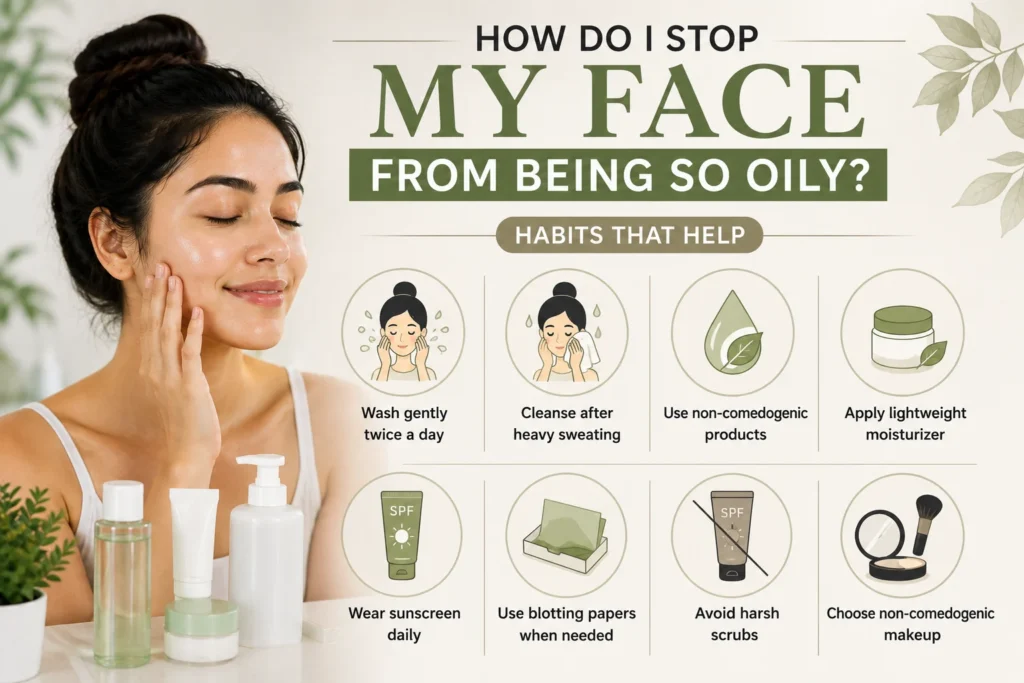
Daily Habits That Help Control Oil:
| Habit | Why It Helps |
|---|---|
| Wash gently twice a day | Removes excess oil without stripping the skin |
| Cleanse after heavy sweating | Prevents sweat and oil from clogging pores |
| Use non-comedogenic products | Reduces risk of clogged pores |
| Apply lightweight moisturizer | Prevents rebound oil production |
| Wear sunscreen daily | Protects skin from UV damage |
| Use blotting papers when needed | Absorbs excess oil without disturbing skincare |
| Avoid harsh scrubs | Prevents irritation and micro-tears |
| Choose non-comedogenic makeup | Reduces pore clogging |
Consistency matters more than using lots of products. A simple routine you follow every day is more effective than a complicated one you skip.
How to Reduce Oily Face Naturally: What Works and What Doesn’t
If you’re looking for how to reduce oily face naturally, start with simple habits rather than aggressive DIY treatments.
✅ Safe, Effective Natural Habits:
| Habit | Why It Works |
|---|---|
| Wash gently twice daily | Removes excess oil without stripping |
| Don’t scrub aggressively | Prevents irritation that can worsen oiliness |
| Stay hydrated | Supports overall skin health |
| Keep your routine simple | Easier to follow and gentler on skin |
| Change pillowcases regularly | Reduces oil and bacteria buildup |
| Keep hair products away from face | Prevents transfer of oils |
| Clean your phone regularly | Reduces oil and dirt transfer |
| Avoid touching your face | Prevents transfer of bacteria and oil |
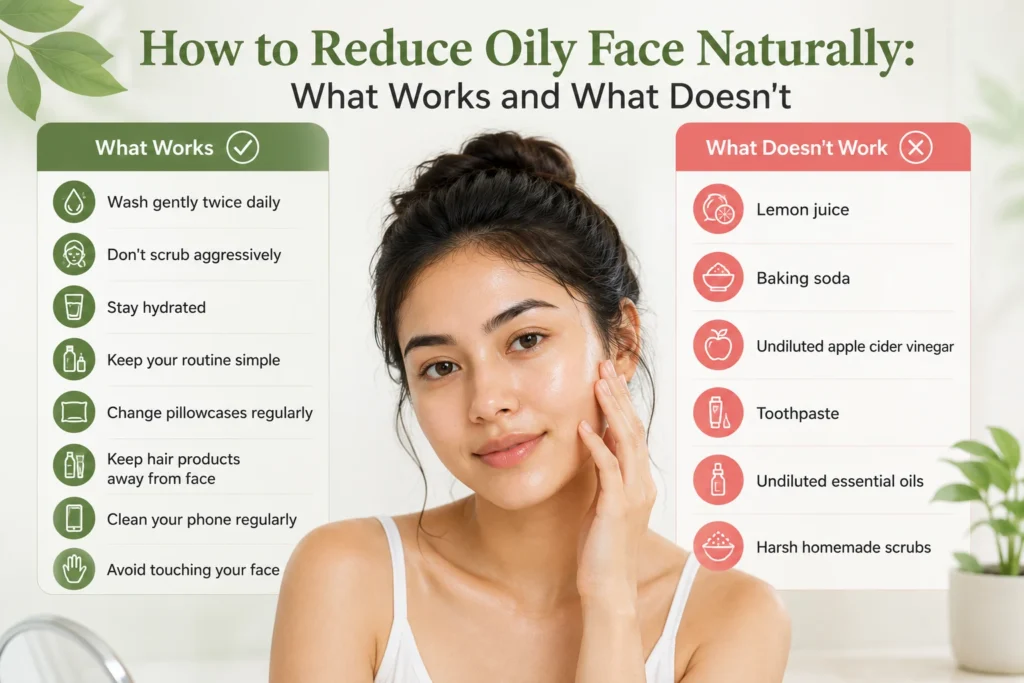
❌ Avoid These DIY “Remedies”:
| Ingredient | Why It’s Harmful |
|---|---|
| Lemon juice | Can cause chemical burns and photosensitivity |
| Baking soda | Too alkaline—damages your skin barrier |
| Undiluted apple cider vinegar | Too acidic—can burn and irritate |
| Toothpaste | Contains ingredients not meant for facial skin |
| Undiluted essential oils | Can cause allergic reactions or burns |
| Harsh homemade scrubs | Can cause micro-tears and irritation |
The takeaway: Irritating your skin isn’t a reliable way to control oil. Focus on gentle, consistent habits instead of experimenting with harsh kitchen ingredients.
How to Reduce Oily Face at Home
There are several practical things you can do at home without building a complicated skincare routine.
Simple Home Habits:
| Habit | How to Do It | Why It Helps |
|---|---|---|
| Wash pillowcases regularly | Change them weekly | Reduces oil, sweat, and bacteria buildup |
| Keep hair products away from face | Avoid heavy products near hairline | Prevents transfer of oils to skin |
| Clean your phone | Wipe the screen daily | Reduces oil and bacteria transfer to cheeks |
| Avoid touching your face | Be conscious of hand-to-face contact | Prevents transfer of bacteria and oil |
| Remove makeup before bed | Always use a gentle makeup remover | Prevents clogged pores overnight |
| Shower after heavy sweating | Wash with gentle cleanser | Removes sweat and oil that can clog pores |
| Change sweaty clothing | Change immediately after exercise | Prevents body breakouts |
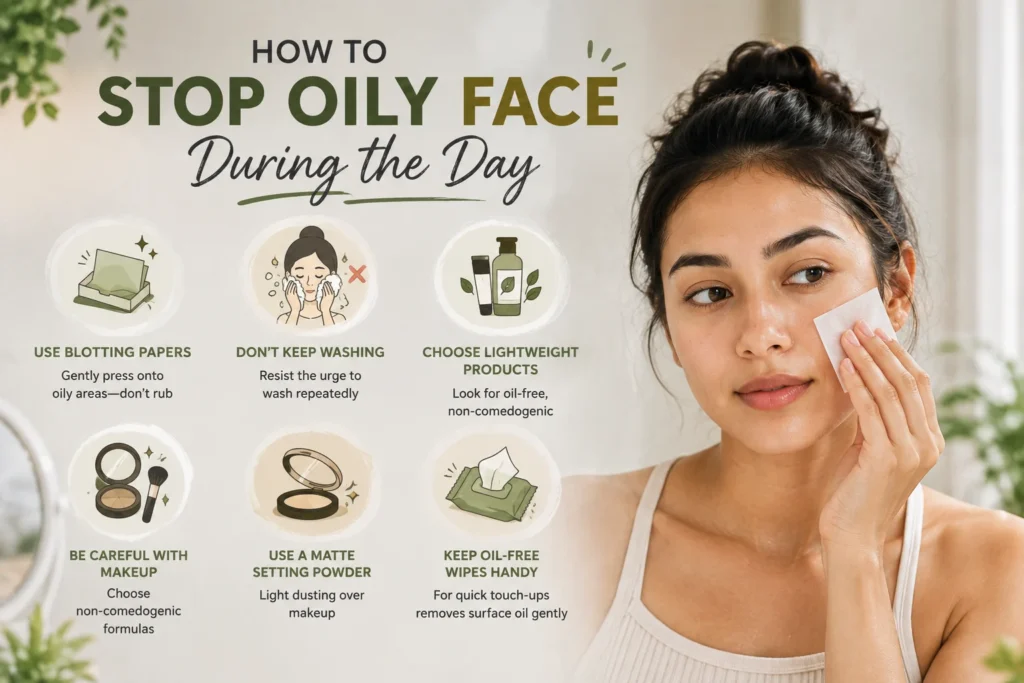
How to Stop Oily Face During the Day
Even if your morning routine works well, oil can return by lunchtime. Here’s how to manage it without repeatedly washing your face.
Daytime Strategies:
| Strategy | How to Do It | Why It Works |
|---|---|---|
| Use blotting papers | Gently press onto oily areas—don’t rub | Absorbs oil without disturbing skincare |
| Don’t keep washing | Resist the urge to wash repeatedly | Over-washing irritates and dries skin |
| Choose lightweight products | Look for oil-free, non-comedogenic | Prevents adding extra grease to skin |
| Be careful with makeup | Choose non-comedogenic formulas | Prevents pore clogging |
| Use a matte setting powder | Light dusting over makeup | Reduces shine without caking |
| Keep oil-free wipes handy | For quick touch-ups | Removes surface oil gently |
Key principle: Don’t try to wash away oil every time you see shine. Your skin produces oil throughout the day—it’s normal. A few blotting papers are usually enough.
How to Get Rid of Oily Face Fast
If you need a quick fix for oily skin, focus on reducing visible surface oil rather than trying to permanently change your skin.
Quick Fixes:
| Step | How to Do It |
|---|---|
| 1 | Gently cleanse your face with lukewarm water |
| 2 | Pat it dry with a clean towel—don’t rub |
| 3 | Apply a lightweight moisturizer |
| 4 | Use blotting paper if your skin becomes shiny |
| 5 | Avoid layering several heavy products |
Important: These steps can make your skin look less greasy temporarily, but there isn’t a safe method that permanently removes your skin’s natural oil in a few minutes. Be wary of any product that promises instant permanent results.
Key Ingredients That Can Help Oily Skin
There isn’t one universal solution that works for everyone, but certain ingredients can be helpful for managing oily skin.
Beneficial Ingredients:
| Ingredient | What It Does | Best For | How to Use |
|---|---|---|---|
| Salicylic acid | Exfoliates inside pores, helps unclog them | Blackheads, whiteheads, clogged pores | In cleansers or leave-on treatments |
| Niacinamide | Supports skin barrier, may reduce excess oil appearance | Oily, acne-prone skin, redness | Serums, moisturizers |
| Benzoyl peroxide | Kills acne-causing bacteria, reduces inflammation | Inflammatory acne, red pimples | Spot treatments, cleansers |
| Hyaluronic acid | Hydrates without heaviness | Dehydrated oily skin | Serums, moisturizers |
| Glycerin | Attracts moisture to the skin | Lightweight hydration | Moisturizers, cleansers |
| Retinoids (adapalene) | Regulates skin cell turnover, unclogs pores | Persistent acne | Nighttime treatment |
Important Rules for Using Active Ingredients:
- Introduce ONE new ingredient at a time—you need to know what works
- Start slowly—use every other night initially
- Don’t combine multiple actives—this can damage your skin barrier
- Be patient—it takes 4-6 weeks to see results
- If irritation occurs—reduce use or stop
Products to Avoid for Oily Skin
| Product Type | Why to Avoid |
|---|---|
| Heavy creams or ointments | Can clog pores and worsen oiliness |
| Physical scrubs with large particles | Can irritate and cause micro-tears |
| Products with high alcohol content | Strip skin, trigger rebound oil production |
| Acetone-based makeup removers | Excessively drying and irritating |
| Pore strips | Can damage skin barrier and enlarge pores |
| DIY remedies (lemon, baking soda, toothpaste) | Can cause burns, irritation, and damage |
| Comedogenic oils (coconut oil, etc.) | Can clog pores |
| Fragranced products | Can irritate sensitive skin |
How to Reduce Oily Face: A Simple Routine
A basic routine can look like this:
Morning ☀️
| Step | Product | Why |
|---|---|---|
| 1 | Gentle cleanser | Removes overnight oil without stripping |
| 2 | Lightweight moisturizer | Hydrates without clogging pores |
| 3 | SPF 30+ sunscreen | Protects from UV damage |
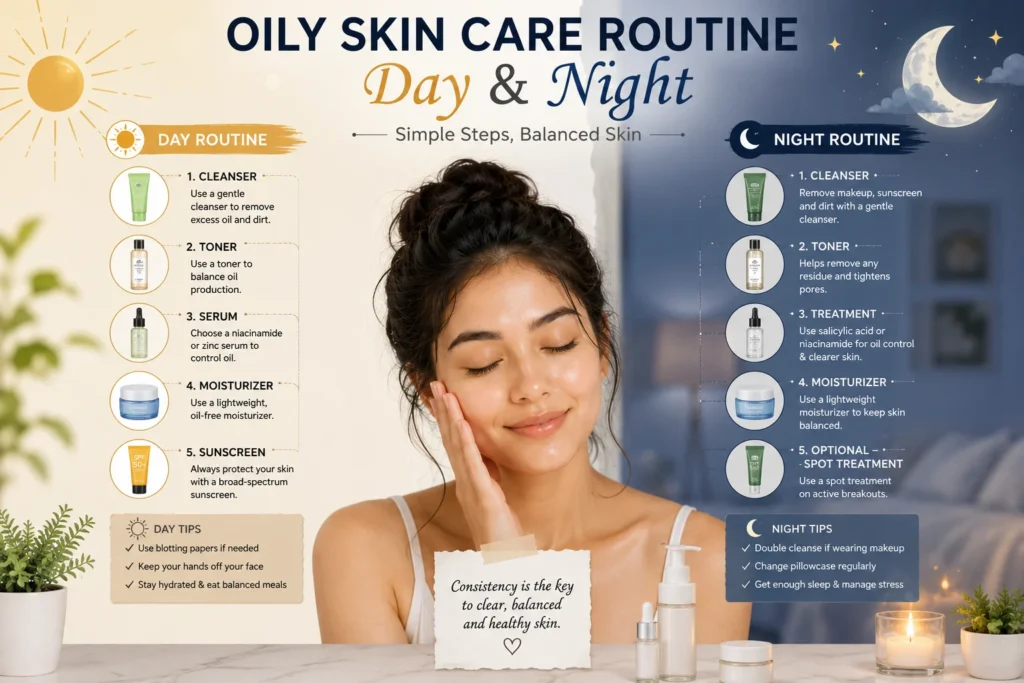
Evening 🌙
| Step | Product | Why |
|---|---|---|
| 1 | Gentle cleanser | Removes sunscreen, makeup, daily buildup |
| 2 | Acne treatment (if needed) | Targets specific concerns |
| 3 | Lightweight moisturizer | Supports skin barrier overnight |
Product Selection Tips:
| Product | What to Look For | What to Avoid |
|---|---|---|
| Cleanser | Gentle, fragrance-free, salicylic acid (if needed) | “Degreasing” cleansers, harsh sulfates |
| Moisturizer | Lightweight, non-comedogenic, gel or lotion | Heavy creams, thick ointments |
| Sunscreen | SPF 30+, broad-spectrum, non-comedogenic | Greasy, heavy formulas |
| Acne treatment | One active ingredient appropriate for your acne | Multiple actives combined |
You don’t need a ten-step routine to manage oily skin. Simplicity and consistency are more important than product count.
How to Reduce Oily Face for Men
The basic approach to how to reduce oily face for men is no different from managing oily skin in anyone else. However, there are a few specific considerations.
Shaving and Oily Skin:
| Tip | Why It Helps |
|---|---|
| Use a clean, sharp razor | Reduces irritation and razor bumps |
| Don’t shave dry skin | Always use shaving cream or gel |
| Shave in the direction of hair growth | Reduces ingrown hairs |
| Avoid harsh aftershaves with alcohol | Prevents dryness and irritation |
| Don’t scrub aggressively after shaving | Prevents irritation |
Post-Exercise Care:
| Step | Why |
|---|---|
| Shower and cleanse after heavy sweating | Removes sweat and oil |
| Change out of sweaty clothing | Prevents body breakouts |
| Use a gentle cleanser | Avoid harsh soaps that strip skin |
Simple Routine for Men:
| Time | Steps |
|---|---|
| Morning | Gentle cleanser → Lightweight moisturizer → SPF 30+ sunscreen |
| Evening | Gentle cleanser → Acne treatment (if needed) → Moisturizer |
Remember: Men’s skin is not fundamentally different from women’s when it comes to oil production. The same gentle, consistent principles apply.
How to Reduce Oily Face and Scalp
Sometimes an oily face appears alongside an oily scalp. This can be especially noticeable if your hair becomes greasy quickly and touches your forehead.
Face vs. Scalp Care:
| Area | How to Manage |
|---|---|
| Face | Gentle cleanser, lightweight moisturizer, sunscreen, keep hair products away |
| Scalp | Wash as often as needed, rinse thoroughly, avoid heavy products near hairline |
Tips for Managing Both:
| Tip | Why It Helps |
|---|---|
| Keep hair products away from face | Prevents transfer to forehead and cheeks |
| Wash after heavy sweating | Removes oil and sweat from both areas |
| Change pillowcases regularly | Reduces oil transfer from hair to face |
| Rinse shampoo and conditioner thoroughly | Prevents residue buildup |
| Avoid heavy styling products | Can transfer to face and clog pores |
When to see a doctor: If your scalp is extremely oily, itchy, flaky, or inflamed, consider speaking with a dermatologist rather than trying increasingly harsh treatments.
Can You Remove Oil From Your Face Permanently?
If you’re searching for how to remove oil from face permanently, it’s important to understand that you generally cannot safely make your skin stop producing sebum altogether.
Why You Need Some Oil:
| Reason | Explanation |
|---|---|
| Protection | Sebum helps protect your skin from environmental damage |
| Hydration | Oil locks in moisture and prevents dryness |
| Barrier function | Oil helps maintain your skin’s protective barrier |
| Antimicrobial properties | Sebum has some natural antimicrobial effects |
What You Can Do:
| Realistic Goal | How to Achieve It |
|---|---|
| Control excess oil | Gentle cleansing, suitable products |
| Reduce shine | Blotting papers, lightweight products |
| Prevent clogged pores | Non-comedogenic products, salicylic acid |
| Manage breakouts | Appropriate acne treatments |
The bottom line: Oil production can also change naturally with age and hormonal changes. The goal should be balanced, comfortable skin, not completely oil-free skin.
When Should You See a Dermatologist?
Oily skin itself isn’t usually a medical problem. However, you may want professional advice if excessive oil comes with:
| Sign | Why You Should See a Doctor |
|---|---|
| Persistent or painful acne | May require prescription treatment |
| Deep or large pimples | Can lead to scarring without proper treatment |
| Acne that is leaving scars | Early intervention can prevent permanent marks |
| Severe irritation | May indicate a skin condition |
| Sudden major changes in your skin | Could signal an underlying issue |
| A skincare routine that isn’t helping | Professional guidance may be needed |
| Oily scalp with itching or flaking | Could be seborrheic dermatitis or another condition |
| Skin concerns affecting your emotional wellbeing | Your mental health matters too |
What a Dermatologist Can Do:
| Service | How It Helps |
|---|---|
| Identify your skin type | Proper diagnosis |
| Recommend appropriate products | Personalized advice |
| Prescribe stronger treatments | When OTC products aren’t enough |
| Offer professional procedures | Extractions, chemical peels, light therapy |
| Treat acne scars | Laser, microneedling, other options |
| Diagnose other conditions | Rule out skin conditions that mimic acne |
Don’t wait until acne becomes severe—early treatment can help control it and reduce the risk of lasting scars.
Frequently Asked Questions
How do I remove oil from my face naturally?
Start with gentle cleansing twice daily, avoid touching your face, keep hair products away from your skin, and use blotting papers when necessary. Avoid harsh DIY ingredients like lemon juice, baking soda, or toothpaste—gentle habits are more effective than aggressive treatments.
What causes an oily face?
Oily skin happens when sebaceous glands produce more sebum than your skin needs at the surface. Genetics, hormones, puberty, weather, stress, and skincare habits can all influence oil production. It’s usually a combination of factors, not just one thing.
What decreases oily skin?
A consistent skincare routine can help manage excess oil. Gentle cleansing, lightweight non-comedogenic products, and certain ingredients such as salicylic acid or niacinamide may be helpful for some people. Consistency matters more than product count.
How can I stop my face from getting oily during the day?
Use a gentle morning routine, avoid heavy products, and carry blotting papers if needed. Try not to repeatedly wash your face whenever shine appears—it can irritate your skin. Lightweight, oil-free products can also help keep shine under control.
Can oily skin be permanently cured?
There isn’t a safe way to permanently stop normal sebum production. However, oiliness can often be managed effectively with suitable skincare and, when necessary, professional treatment. As you age, oil production may naturally decrease.
Is oily skin bad for me?
No. Oily skin is common and isn’t inherently unhealthy. The concern is usually excess oil combined with clogged pores or acne. A gentle routine can help manage shine and breakouts effectively.
Should I use moisturizer if I have oily skin?
Absolutely yes. Oily skin still needs hydration. Choose a lightweight, non-comedogenic moisturizer that feels comfortable. Skipping moisturizer can actually make your skin produce more oil in response to dehydration.
Can stress make oily skin worse?
Yes. Stress can trigger hormonal changes that increase oil production. Managing stress through exercise, adequate sleep, and relaxation techniques may help your skin.
How long does it take to see results from a skincare routine?
Most skincare products take at least 4-6 weeks of consistent use to show noticeable results. Don’t give up after a week or two. If a product causes significant irritation, stop using it. Otherwise, be patient and consistent.
Does diet affect oily skin?
While research is ongoing, some studies suggest that high-glycemic foods (sugary foods, refined carbs) and dairy may worsen acne in some people. However, diet is rarely the sole cause of oily skin. A balanced diet supports overall health, but don’t expect dietary changes alone to cure oily skin.
Final Thoughts
Learning how to reduce oily face problems isn’t about removing every bit of oil from your skin. Sebum has an important protective role, so the aim is to control excess oil while keeping your skin barrier comfortable.
Quick Recap:
| Priority | Action |
|---|---|
| 1 | Cleanse gently twice daily with lukewarm water |
| 2 | Use a lightweight, non-comedogenic moisturizer |
| 3 | Apply SPF 30+ sunscreen every morning |
| 4 | Add acne treatment if needed (start with one) |
| 5 | Use blotting papers for daytime shine |
| 6 | Keep your routine simple and consistent |
Choose the Right Approach:
| Concern | Solution |
|---|---|
| Blackheads and clogged pores | Salicylic acid |
| Red, inflamed pimples | Benzoyl peroxide |
| Persistent acne | Adapalene or see a dermatologist |
| Excess shine during the day | Blotting papers, lightweight products |
| Oily skin with irritation | Simplify routine, use gentle products |
The Most Important Message:
- Your skin needs some natural oil to stay healthy
- The goal is balanced, comfortable skin—not perfectly matte all day
- Occasional shine is normal—it doesn’t mean you’re doing something wrong
- Be patient with your skin and kind to yourself
For most people, the best starting point is surprisingly simple: cleanse gently, moisturize, use sunscreen, avoid irritating DIY treatments, and stay consistent with your routine.
If oily skin is accompanied by persistent or severe acne, don’t feel that you have to manage it alone. A dermatologist can help you find an approach suited to your skin.
Medical disclaimer: This article is for general educational purposes and does not replace professional medical advice. If you have persistent, painful, or severe acne, or if your skin concerns are affecting your wellbeing, speak with a dermatologist or qualified healthcare professional.

Hannah Collins is a skincare writer focused on simple routines, trusted ingredient research, and practical advice for healthy, glowing skin.