
Oily skin is very common during the teenage years. Puberty and hormonal changes can increase oil production, making your face look shiny, greasy, or more prone to clogged pores and breakouts.
If you are wondering how to fix oily skin as a teen, you do not need a complicated skincare routine. The most helpful approach is to cleanse gently, moisturize, use non-comedogenic products, protect your skin from the sun, and avoid trying to remove every bit of natural oil.
You also do not need harsh homemade treatments to control oily skin. Simple home-care habits can help reduce excess shine and keep your skin comfortable while you build a routine that works for you.
This guide covers the best oily skin tips for teens at home, teenage skincare products, simple home-care remedies, and an easy morning and night routine.
Why Do Teenagers Have Oily Skin?
During puberty, hormonal changes can increase activity in the skin’s oil glands. As a result, more sebum may reach the surface of your skin.
You may notice:
- A shiny forehead, nose, or cheeks
- Oil appearing again after washing your face
- Blackheads or clogged pores
- More frequent pimples
- Makeup becoming greasy during the day
- More noticeable pores
Oily skin does not mean your face is dirty. Sebum is a normal part of healthy skin and helps protect it.
The goal is to manage excess oil without irritating your skin or stripping away all of its natural moisture.
How to Fix Oily Skin as a Teen
If you are asking, “How to fix oily skin as a teen?”, start with these basic habits:
- Cleanse your face gently up to twice a day and after sweating.
- Choose a mild cleanser instead of a harsh face wash.
- Look for oil-free and non-comedogenic products.
- Use a lightweight moisturizer after cleansing.
- Wear broad-spectrum SPF 30 or higher during the day.
- Remove makeup before going to bed.
- Use blotting papers when your face becomes shiny.
- Avoid aggressive scrubbing.
- Try not to touch your face throughout the day.
- Introduce oil-control or acne ingredients slowly if you need them.
A simple routine that you can follow consistently is usually more useful than a shelf full of skincare products.
10 Oily Skin Tips for Teens at Home
1. Cleanse Your Face Gently
One of the simplest oily skin tips for teens at home is regular, gentle cleansing.
Wash your face up to twice a day and after sweating. Use a mild cleanser and lukewarm water, then gently pat your skin dry.
Avoid scrubbing your face to remove oil. Irritated skin can become red, uncomfortable, and more difficult to manage.
2. Choose a Gentle Face Wash
When your face feels greasy, you may be tempted to use the strongest cleanser you can find.
A harsh cleanser is not necessary for oily skin. Instead, look for a gentle face wash that removes excess oil without leaving your skin feeling painfully tight or dry.
When choosing teenage oily skin care products, pay attention to how your skin actually feels after using them rather than choosing a product simply because it promises “deep oil control.”
3. Choose Oil-Free and Non-Comedogenic Products
If you have oily or acne-prone skin, consider products labeled oil-free and non-comedogenic.
Non-comedogenic products are designed to be less likely to clog pores.
This can be useful when choosing cleansers, moisturizers, sunscreen, and makeup.
However, everyone’s skin is different. A product that works well for another teenager may not suit your skin.
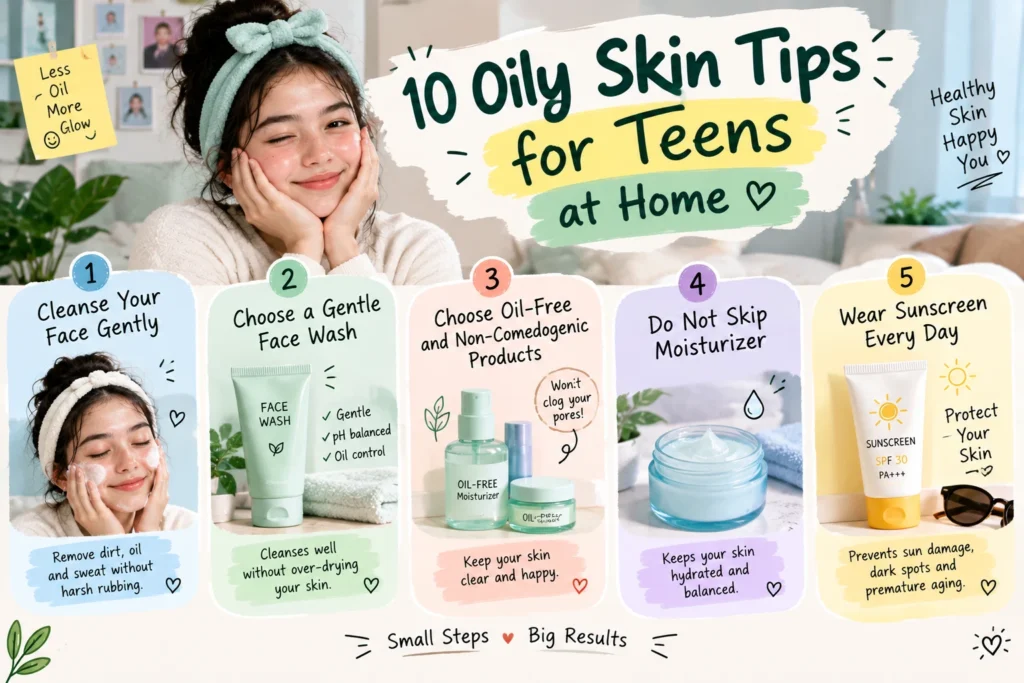
4. Do Not Skip Moisturizer
One common mistake is avoiding moisturizer because your skin is already oily.
Oily skin still needs hydration.
After cleansing, apply a lightweight moisturizer that feels comfortable on your skin. If you are prone to clogged pores, choose a non-comedogenic formula.
Keeping moisturizer in your routine can also make it easier to tolerate certain acne or oil-control ingredients.
5. Wear Sunscreen Every Day
Sunscreen is an important part of teenage skincare, even if your main concern is excess oil.
Use a broad-spectrum sunscreen with SPF 30 or higher when you are exposed to the sun.
If sunscreen makes your face feel greasy, look for a lightweight, oil-free, or non-comedogenic formula.
Sun protection helps protect your skin from UV damage and is an important habit to start during your teenage years.
How to Remove Oily Skin Naturally
If you are searching for how to remove oily skin naturally, remember that you cannot safely remove your skin’s natural oil permanently.
Your skin needs some sebum.
Instead, focus on reducing excess surface oil with simple habits such as:
- Gentle cleansing
- Using suitable skincare products
- Blotting excess oil during the day
- Removing makeup before bed
- Avoiding unnecessary face touching
- Keeping makeup tools clean
- Avoiding harsh DIY ingredients
- Using moisturizer and sunscreen consistently
These habits can help your skin look less greasy without trying to completely stop natural oil production.
Can You Remove Oil From Your Face Permanently?
No. There is no safe home remedy that can permanently stop your skin from producing oil.
Sebum is naturally produced by the sebaceous glands, and teenage hormones can make oil production more noticeable during puberty.
So if you are searching for how to remove oil from face permanently, a better goal is to control excess oil rather than eliminate it.
If your skin is extremely oily and you also have persistent blackheads, frequent acne, or painful breakouts, a dermatologist can help determine whether you need additional treatment.
How to Stop a Very Oily Face During the Day
If your face becomes very oily a few hours after washing, repeatedly cleansing it is not the only solution.
Try these habits instead.
Use blotting papers
Blotting papers can absorb excess surface oil during the day.
Press one gently against the oily area for a few seconds. Avoid rubbing it across your face.
Choose lightweight skincare
Heavy or greasy-feeling products may be uncomfortable if your skin is already very oily.
Look for lightweight formulas that suit your skin and are labeled non-comedogenic when appropriate.
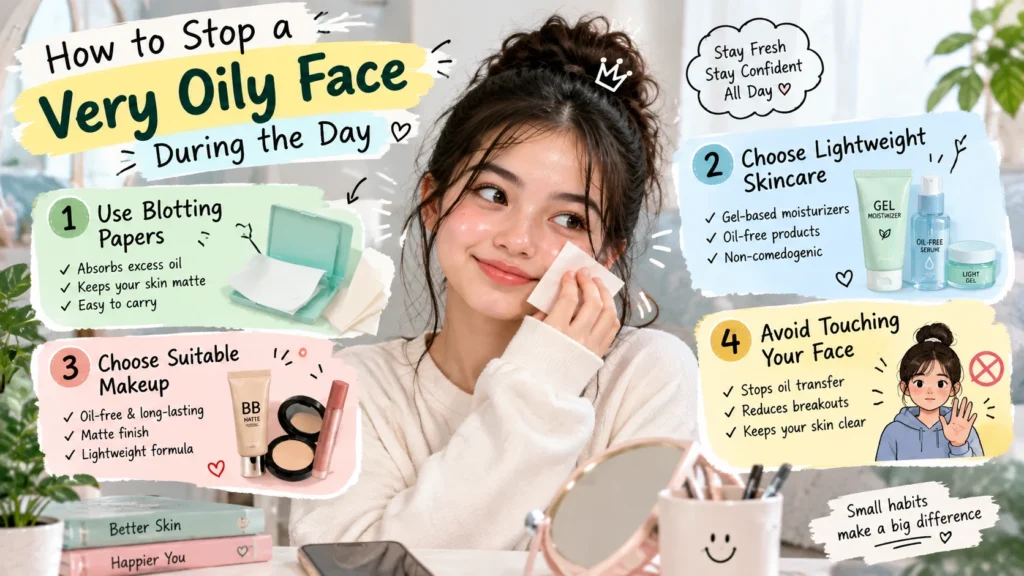
Choose suitable makeup
If you wear makeup, oil-free, water-based, or matte formulas may help reduce visible shine.
Always remove makeup before sleeping.
Avoid touching your face
Touching your face can transfer oil, dirt, and other debris from your hands to your skin.
Try to touch your face only when necessary, and wash your hands before applying skincare or makeup.
Teenage Skin Care Routine at Home
A teenage skin care routine home remedies approach does not need complicated homemade masks.
For most teenagers, a simple routine is a better starting point.
Morning
1. Cleanse
Wash your face gently with a mild cleanser.
2. Moisturize
Apply a lightweight moisturizer suitable for your skin type.
3. Sunscreen
Finish with broad-spectrum SPF 30 or higher.
During the day
If your face becomes shiny, use blotting papers instead of repeatedly washing your face.
If you spend time outdoors, follow the sunscreen’s directions for reapplication.
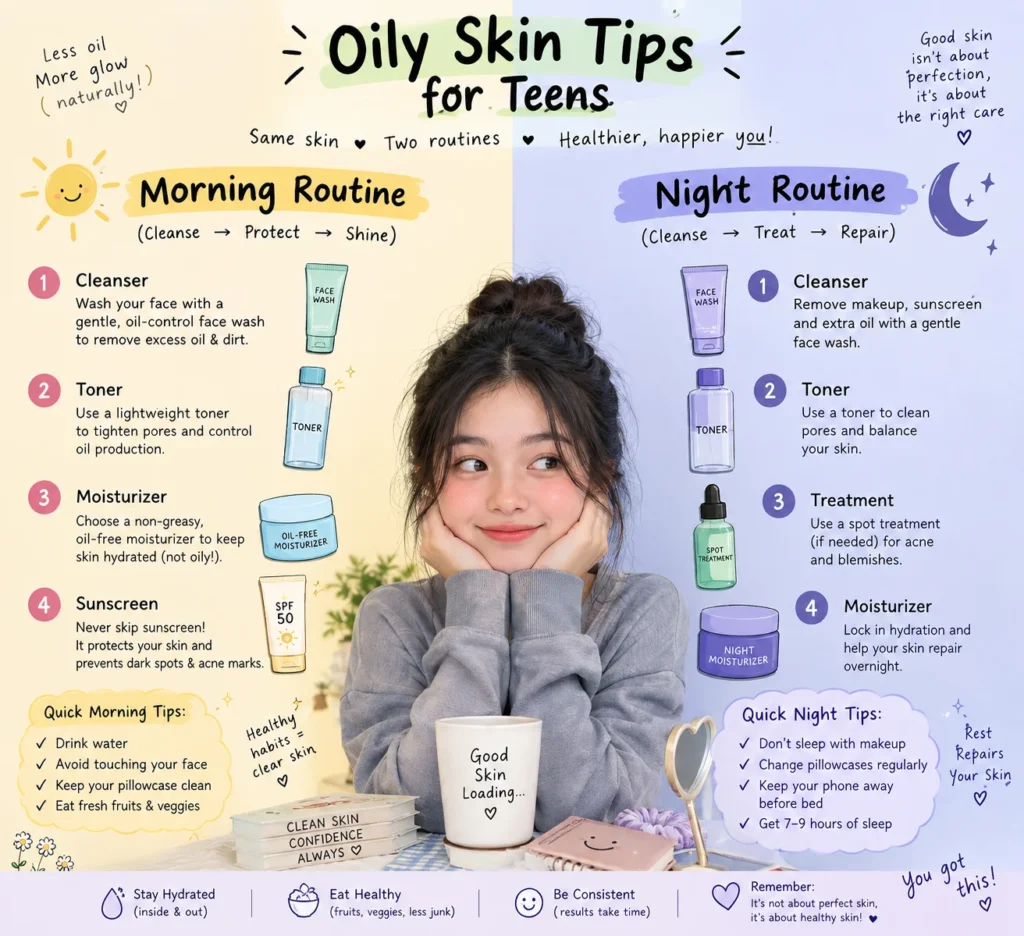
Night
1. Remove makeup
If you wear makeup, remove it completely before bed.
2. Cleanse
Wash your face gently.
3. Moisturize
Apply your lightweight moisturizer.
That is enough for a basic teenage routine.
If you have acne or clogged pores, you can consider adding a targeted ingredient later rather than introducing several active products at once.
Natural Skin Care Routine for Teenage Girl
A natural skin care routine for a teenage girl does not have to mean using ingredients from the kitchen.
A gentle routine based on simple habits can be more appropriate for young skin:
Morning
- Gentle cleanser
- Lightweight moisturizer
- SPF 30+ sunscreen
During the day
- Blot excess oil when needed
- Avoid touching your face
- Protect your skin from the sun
Night
- Remove makeup
- Gentle cleanser
- Moisturizer
You do not need lemon juice, baking soda, toothpaste, or rough sugar scrubs to care for oily skin.
Natural does not automatically mean safe for facial skin.
Safe Home Care for Oily Skin
Some simple home-care habits can help you manage oily skin without using harsh DIY ingredients.
Blot excess oil
Blotting papers can help reduce shine without repeatedly washing your face.
Keep your pillowcase clean
Changing pillowcases regularly is a simple hygiene habit, especially if you have oily or acne-prone skin.
Clean makeup tools
If you use makeup, wash brushes and applicators regularly to remove accumulated makeup and oil.
Keep your hands away from your face
Avoid picking, squeezing, or repeatedly touching your skin.
Avoid harsh DIY treatments
Do not assume that an ingredient is safe for your face simply because it is natural.
Lemon juice, baking soda, toothpaste, and abrasive scrubs can irritate facial skin and are not necessary for controlling teenage oiliness.
Ingredients That May Help Oily Teenage Skin
If basic skincare is not enough, certain ingredients may help with oiliness, clogged pores, or breakouts.
Salicylic acid
Salicylic acid can help exfoliate inside clogged pores and may be useful for oily or acne-prone skin.
If you are new to it, start gradually and follow the product directions.
Niacinamide
Niacinamide, a form of vitamin B3, is commonly used in skincare and may help support the skin barrier and improve the appearance of excess oil.
Glycolic acid
Glycolic acid is an exfoliating ingredient that can improve skin texture, but it may irritate some people.
Lactic acid
Lactic acid is another exfoliating ingredient that may help improve skin texture.
You do not need to use all of these ingredients.
For a teenager who is new to skincare, starting with a gentle cleanser, moisturizer, and sunscreen is usually a much simpler approach.
How Can a 14-Year-Old Get Clear Skin?
If you are wondering “How can a 14 year old get clear skin?”, focus on healthy and consistent skincare rather than trying to make your skin completely poreless.
At 14, your skin may still be changing because of puberty and hormones.
Helpful habits include:
- Wash your face gently twice a day.
- Use a lightweight moisturizer.
- Wear sunscreen.
- Choose non-comedogenic skincare and makeup.
- Remove makeup before bed.
- Avoid picking pimples.
- Do not scrub your face aggressively.
- Introduce new products one at a time.
- Ask a dermatologist for help if acne is persistent or painful.
Clear skin does not mean never having a pimple.
Teenage skin naturally changes, and occasional breakouts do not mean you are doing something wrong.
Best Oily Skin Tips for Teens
The best oily skin tips for teens are usually simple habits that you can maintain consistently.
| Tip | Why it helps |
|---|---|
| Cleanse gently | Removes excess oil, sweat, and daily buildup |
| Avoid over-washing | Helps reduce unnecessary irritation |
| Choose non-comedogenic products | Less likely to clog pores |
| Moisturize | Helps maintain skin hydration |
| Wear SPF 30+ | Protects skin from UV damage |
| Use blotting papers | Helps control daytime shine |
| Remove makeup before bed | Keeps makeup from remaining on the skin overnight |
| Avoid touching your face | Reduces transfer of oil and dirt |
| Introduce active ingredients slowly | Helps reduce irritation |
| See a dermatologist for persistent acne | Provides personalized treatment when needed |
How to Make an Oily Face Glow
If you want to know how to make oily face glow, do not confuse a healthy glow with greasy shine.
You do not need to remove all of your natural oil to make your skin look fresh.
Try these habits:
- Keep your skin clean without over-washing.
- Use a lightweight moisturizer.
- Wear sunscreen every day.
- Keep your skin hydrated.
- Use suitable exfoliating ingredients if your skin tolerates them.
- Blot excess oil when necessary.
- Choose lightweight or matte makeup if you wear it.
- Avoid harsh products that leave your skin irritated and uncomfortable.
Healthy-looking skin is usually the result of consistent care, not completely oil-free skin.
Oily Skin, Pimples, and Teen Acne
Oily skin can contribute to clogged pores and breakouts, but it is not the only reason teenagers develop acne.
Hormonal changes during puberty can increase oil production and make acne more likely.
If you have occasional pimples, a gentle skincare routine may be enough.
However, consider seeing a dermatologist if you have:
- Painful or deep pimples
- Frequent or persistent breakouts
- Acne that is leaving scars or dark marks
- Large numbers of blackheads
- Significant skin irritation
- Acne that is affecting your confidence
You do not have to wait until acne becomes severe before asking for professional help.
Oily Skin Mistakes Teens Should Avoid
Washing your face too often
Washing more frequently does not guarantee less oil. It can also make your skin irritated.
Scrubbing aggressively
Scrubbing hard can damage or irritate the skin and is not necessary for removing oil.
Using alcohol-based products
Strong alcohol-based cleansers can be irritating and are not essential for controlling oily skin.
Using too many active ingredients
Combining multiple acids, acne products, scrubs, and masks can make irritation more likely.
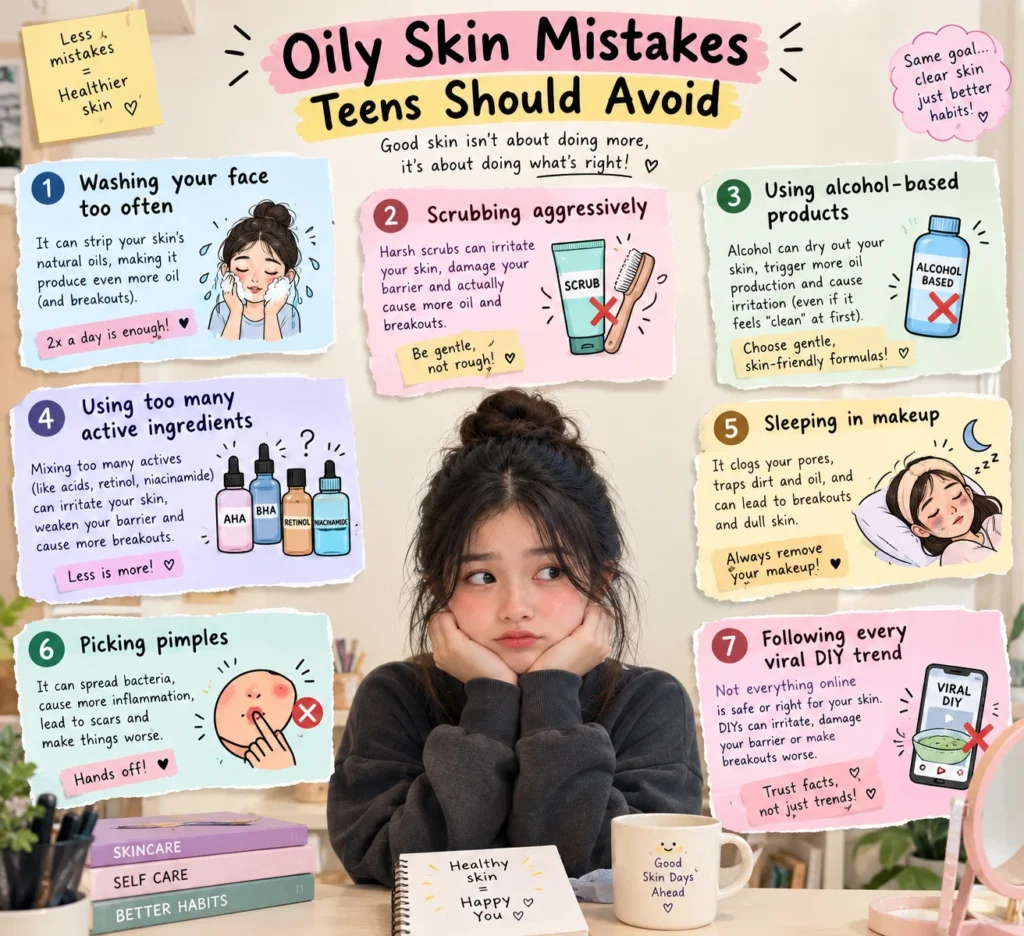
Sleeping in makeup
Always remove makeup before going to sleep.
Picking pimples
Squeezing or picking breakouts can increase inflammation and may contribute to marks or scarring.
Following every viral DIY trend
A skincare hack being popular online does not mean it is safe or appropriate for teenage skin.
When Should a Teenager See a Dermatologist?
Home care can help manage everyday oiliness, but some skin concerns need professional treatment.
Consider seeing a dermatologist if you have persistent or painful acne, frequent blackheads, significant scarring, or skin irritation that does not improve.
A dermatologist can assess your skin and recommend treatment based on your specific concerns.
Frequently Asked Questions
How do I fix oily skin as a teen?
Start with gentle cleansing, a lightweight moisturizer, and daily SPF 30+ sunscreen. Choose non-comedogenic products, avoid harsh scrubbing, and use blotting papers to manage excess shine during the day.
How can I stop a very oily face?
Cleanse gently up to twice daily and after sweating, choose lightweight products, use blotting papers during the day, and avoid repeatedly washing or scrubbing your face.
How can I remove oily skin naturally?
You cannot permanently remove your skin’s natural oil. Instead, manage excess shine with gentle cleansing, suitable skincare, blotting papers, and consistent daily habits.
Can I permanently remove oil from my face?
No. Your skin naturally produces sebum, and teenage hormones can increase oil production. The goal is to control excess oil while keeping your skin healthy and comfortable.
What are the best oily skin tips for teens?
Use a gentle cleanser, moisturize, wear SPF 30+, choose non-comedogenic products, remove makeup before bed, avoid touching your face, and do not over-wash or aggressively scrub your skin.
What skincare products are best for teenage oily skin?
A gentle cleanser, lightweight moisturizer, and broad-spectrum sunscreen are a good starting point. Depending on your skin concerns, ingredients such as salicylic acid or niacinamide may also be useful.
How can a 14-year-old get clear skin?
A 14-year-old can support clearer-looking skin by cleansing gently, moisturizing, wearing sunscreen, choosing non-comedogenic products, avoiding picking, and keeping the routine simple. Persistent or painful acne may need professional treatment.
How can I make my oily face glow?
Keep your skin hydrated, cleanse gently, use sunscreen, and avoid stripping away all of your natural oil. A healthy glow does not require completely oil-free skin.
Are home remedies safe for teenage oily skin?
Some simple home-care habits are safe, but harsh DIY ingredients can irritate the skin. Avoid using lemon juice, baking soda, toothpaste, or abrasive scrubs on your face.
Does oily skin mean my face is dirty?
No. Oily skin is usually related to natural sebum production and, during the teenage years, hormonal changes. Having oily skin does not mean your face is unclean.
Final Thoughts
Oily skin can be frustrating during the teenage years, especially when your face becomes shiny soon after washing. But trying to remove every trace of oil is not the answer.
The better approach is to control excess oil while protecting your skin’s natural moisture barrier.
Keep your routine simple: cleanse gently, moisturize, wear sunscreen, choose non-comedogenic products, and avoid excessive washing and scrubbing. Blotting papers can help with daytime shine, while ingredients such as salicylic acid or niacinamide may be useful for specific concerns.
Most importantly, do not expect perfectly clear or poreless skin. Teenage skin naturally changes during puberty, and occasional oiliness and breakouts are common.
If your acne is painful, persistent, or leaving scars, a dermatologist can help you find a treatment that is appropriate for your skin.
Note: This article provides general skincare information and is not a substitute for personalized medical advice. If you have persistent acne, severe irritation, or concerns about your skin, speak with a qualified dermatologist.

Sophie Carter is a skincare writer who shares science-backed skincare routines, ingredient insights, and everyday tips for healthier-looking skin.