Waking up with new pimples, oily skin, or sudden breakouts can feel frustrating—especially during school days when confidence matters. Many teens try random skincare products or viral hacks, but using too many products or harsh treatments can irritate the skin instead of helping it.
The good news is that a skincare routine for teens does not need to be complicated. During the teenage years, hormonal changes can increase oil production, which can contribute to clogged pores, blackheads, whiteheads, and pimples. A simple, consistent routine can help keep teenage skin clean, balanced, and healthy.
In this guide, you’ll learn how to build a simple morning and night routine, choose products for your skin type, understand useful skincare ingredients, care for acne-prone skin, avoid common mistakes, and create a routine that is easy to follow consistently.
🌸 Why Teenage Skin Changes So Much
During puberty, the body produces more hormones called androgens. These hormones can stimulate the sebaceous glands, causing them to produce more sebum, or natural skin oil.
Sebum itself is not bad. It helps protect and moisturize the skin. However, when excess oil combines with dead skin cells, pores can become clogged. This can contribute to acne and other common teenage skin concerns.
🔥 What Teens Commonly Experience
- Oily forehead and nose
- Sudden pimples before important events
- Whiteheads on the cheeks or forehead
- Blackheads around the nose and chin
- Increased skin sensitivity
- Uneven skin texture
- Occasional breakouts
Teenage skin can also become irritated easily. Harsh scrubs, excessive exfoliation, and using several strong active ingredients at once may weaken the skin barrier and cause dryness or irritation.
🧠 Types of Teenage Acne
Understanding the different types of acne can help you choose appropriate care instead of treating every breakout the same way.
1. Whiteheads
Whiteheads form when a pore becomes clogged and remains closed at the surface.
✔ Small, flesh-colored or white bumps
✔ Usually not inflamed at first
✔ Often appear on the forehead, cheeks, and chin
2. Blackheads
Blackheads are clogged pores that remain open at the surface. Their dark appearance comes from oxidation, not dirt.
✔ Dark-looking spots
✔ Common around the nose and chin
✔ Not caused simply by poor hygiene
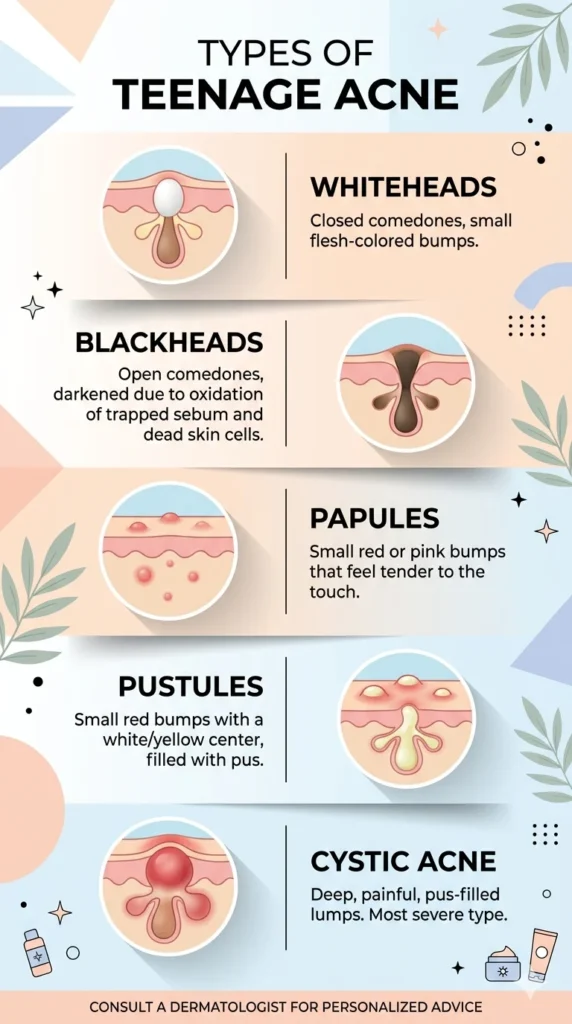
3. Papules
Papules are small, inflamed acne bumps.
✔ Red or pink
✔ Often tender
✔ Usually do not contain visible pus
4. Pustules
Pustules are inflamed pimples that contain pus.
✔ Red or inflamed base
✔ White or yellowish center
✔ Can be tempting to pop, but squeezing them may increase irritation and the risk of marks
5. Cystic or Nodular Acne
Deep, painful acne lesions can develop beneath the skin.
✔ Painful or tender
✔ Swollen lumps
✔ May increase the risk of acne scars
✔ Severe or persistent acne should be evaluated by a dermatologist
☀️ Morning Skincare Routine for Teens
A simple morning routine focuses on cleansing, hydration, and protection from the sun.
Step 1: Cleanser
A gentle cleanser can remove excess oil, sweat, and buildup without unnecessarily stripping the skin.
How to cleanse properly:
- Use lukewarm water
- Apply a small amount of cleanser
- Massage gently rather than scrubbing
- Rinse thoroughly
- Pat your face dry with a clean towel
You do not need to scrub your face aggressively to make it cleaner. Over-cleansing can leave the skin dry and irritated.
🔬 Helpful Cleanser Ingredients
Salicylic Acid (BHA)
Salicylic acid is a common acne-care ingredient that can help loosen dead skin cells and excess oil inside clogged pores.
✔ Helps unclog pores
✔ Can improve blackheads and whiteheads
✔ Useful for acne-prone and oily skin
It can be found in:
- Gel cleansers
- Face washes
- Acne treatments
- Some leave-on products
If your skin is sensitive or becomes dry easily, start with a lower-frequency product and follow its instructions rather than using salicylic acid excessively.
Ceramides
Ceramides are lipids naturally found in the skin barrier.
✔ Help support the skin barrier
✔ Reduce moisture loss
✔ Can help soothe dry or irritated skin
They are commonly found in:
- Moisturizers
- Gentle cleansers
- Barrier-supporting creams
Hyaluronic Acid
Hyaluronic acid is a humectant that helps attract and hold water in the skin.
✔ Supports hydration
✔ Helps skin feel softer
✔ Can be useful when acne treatments cause dryness
It is commonly found in:
- Serums
- Gel moisturizers
- Hydrating creams
Step 2: Moisturizer
Moisturizer is important even if your skin is oily.
When acne treatments or excessive cleansing make the skin too dry or irritated, maintaining the skin barrier becomes more difficult. A suitable moisturizer can help support hydration without necessarily making acne worse.
Types of Moisturizers
Gel moisturizer
- Lightweight
- Often comfortable for oily skin
- Absorbs easily
Lotion
- Provides moderate hydration
- Suitable for normal or combination skin
Cream
- Richer hydration
- Useful for dry or sensitive skin
Look for products labeled non-comedogenic if you are prone to clogged pores.
🔬 Niacinamide
Niacinamide is a form of vitamin B3 commonly used in skincare.
✔ Supports the skin barrier
✔ Can help reduce excess oil
✔ May help improve the appearance of redness and uneven skin tone
✔ Can support smoother-looking skin
It can be found in:
- Serums
- Moisturizers
- Gel creams
You do not need a separate niacinamide serum if your moisturizer already contains it.
Step 3: Sunscreen ☀️
Sunscreen is an important part of a daytime skincare routine, particularly when you spend time outdoors.
✔ Helps protect skin from UV damage
✔ Helps prevent dark acne marks from becoming darker
✔ Supports more even-looking skin
✔ Helps protect against premature skin aging
How to Apply Sunscreen
- Apply it as the last step of your morning routine
- Use enough to cover the face and exposed areas
- Reapply according to the product directions, especially after sweating, swimming, or spending extended time outdoors
For acne-prone skin, a lightweight, non-comedogenic sunscreen may feel more comfortable.
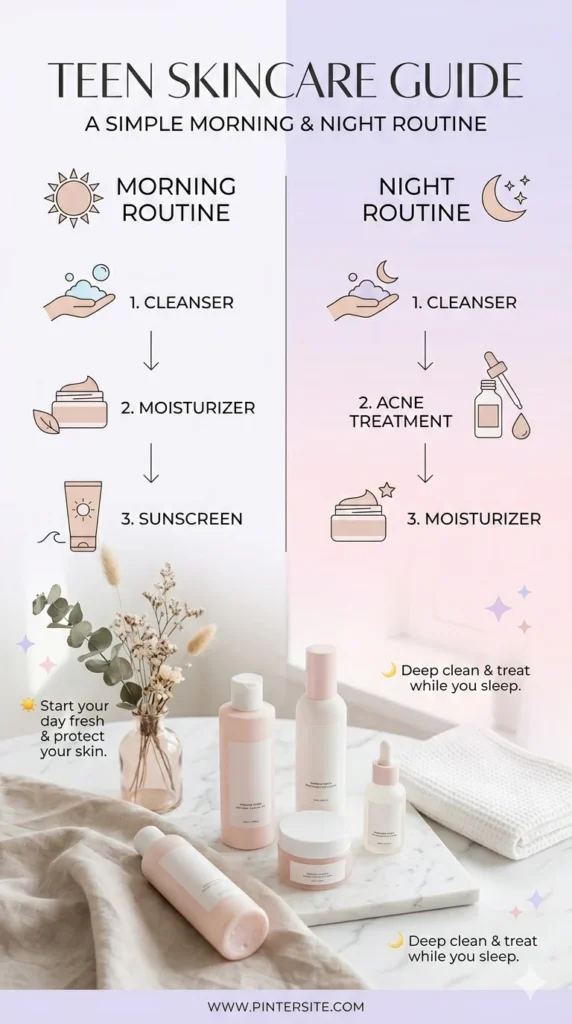
🌙 Night Skincare Routine for Teens
Your nighttime routine can be simple:
Cleanser → Acne treatment if needed → Moisturizer
You do not need multiple active ingredients every night.
Step 1: Cleanser Again
At night, cleansing can remove:
- Sunscreen
- Excess oil
- Sweat
- Makeup
- Daily buildup
If you wear makeup or sunscreen, make sure it is properly removed before bed.
Step 2: Acne Treatment
Different acne treatments work in different ways. You do not need to use all of them together.
Benzoyl Peroxide
Benzoyl peroxide is commonly used for inflammatory acne.
✔ Helps reduce acne-causing bacteria
✔ Can reduce inflamed pimples
✔ Available in washes and leave-on treatments
It can cause dryness or irritation, so follow the product instructions and start gradually if recommended.
Azelaic Acid
Azelaic acid can be useful for acne-prone skin and post-acne discoloration.
✔ Helps reduce acne
✔ Can calm redness
✔ May improve the appearance of dark marks left after acne
Sensitive skin may need a gradual introduction.
Glycolic Acid
Glycolic acid is an alpha hydroxy acid (AHA) that exfoliates the surface of the skin.
✔ Helps remove dead skin cells
✔ Can improve the appearance of uneven texture
✔ May help improve some post-acne marks over time
Because it can irritate sensitive or acne-prone skin, avoid overusing it or combining it with several other strong exfoliating products.
Retinoids
Topical retinoids can help prevent clogged pores and are commonly used to treat acne.
✔ Help keep pores from becoming clogged
✔ Can improve acne over time
✔ Support normal skin-cell turnover
Because retinoids can cause dryness and irritation, teenagers should use an appropriate product according to medical or product guidance.
If acne is persistent, painful, severe, or leaving scars, a dermatologist can recommend the most suitable treatment.
🧴 Product Layering Order
Keeping your routine simple makes product layering easier.
Morning:
Cleanser → Treatment or Serum → Moisturizer → Sunscreen
Night:
Cleanser → Acne Treatment → Moisturizer
Not every teen needs a serum or multiple treatments. A basic routine can be enough for healthy skin.
⚖️ Safe vs. Risky Ingredient Combinations
Some skincare ingredients can be used together, while combining several strong actives may increase irritation.
✔ Generally Simple Combinations
- Niacinamide + moisturizer
- Salicylic acid + moisturizer
- Benzoyl peroxide + moisturizer
- Hyaluronic acid + ceramides
❌ Avoid Overcomplicating Your Routine
- Using several strong acids together
- Adding multiple acne treatments at once
- Exfoliating too frequently
- Changing products every few days
- Using strong actives on already irritated skin
If you are unsure whether two active ingredients can be used together, follow the product instructions or ask a dermatologist or pharmacist.
📅 Weekly Skincare Habits
You do not need an elaborate weekly skincare routine. Small habits can make your routine easier to maintain.
✔ Wash pillowcases regularly
✔ Clean your phone regularly
✔ Avoid touching or picking your face
✔ Avoid excessive exfoliation
✔ Use a gentle hydrating product if your skin feels dry
✔ Keep makeup tools clean
If your daily routine already includes an exfoliating acne treatment, adding extra scrubs or exfoliating masks may cause unnecessary irritation.
🧑🎓 Skin Type Guide
Oily Skin
Try:
- Gentle or salicylic-acid cleanser
- Lightweight moisturizer
- Non-comedogenic sunscreen
Dry Skin
Try:
- Gentle cream or hydrating cleanser
- Hydrating ingredients such as hyaluronic acid
- Ceramide-rich moisturizer
- Gentle sunscreen
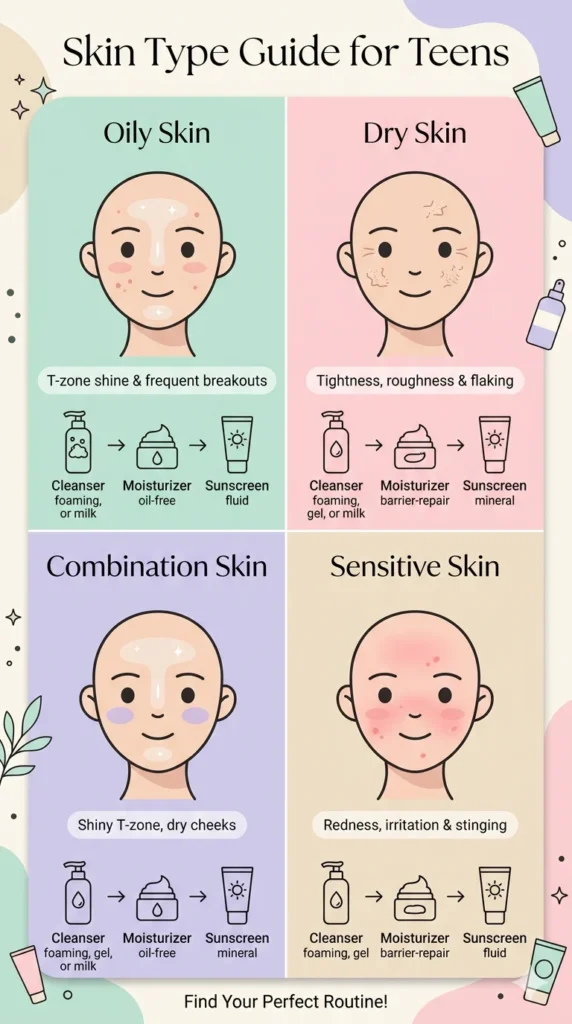
Combination Skin
Try:
- Gentle cleanser
- Lightweight moisturizer
- Targeted acne treatment where needed
- Sunscreen
Sensitive Skin
Try:
- Fragrance-free products
- Gentle cleanser
- Simple moisturizer
- Minimal active ingredients
- Barrier-supporting products
Always introduce new active ingredients gradually, especially if your skin is sensitive.
🚫 Common Teen Skincare Mistakes
Avoid these common habits:
Washing Your Face Too Often
Cleansing excessively can cause dryness and irritation.
Popping Pimples
Squeezing pimples can increase inflammation and may increase the risk of post-acne marks or scarring.
Using Too Many Products
More products do not automatically mean better results.
Switching Routines Constantly
Changing products every few days makes it difficult to know what is helping or irritating your skin.
Following TikTok Trends Blindly
A product that works for someone else may not suit your skin.
Skipping Sunscreen
Regular sun protection is especially important when you are using products that can make skin more sensitive to the sun.
⚖️ DOs vs. DON’Ts
| ✔ DO | ❌ DON’T |
|---|---|
| Wash your face gently | Wash your face excessively |
| Use a gentle cleanser | Use harsh soaps or scrubs |
| Moisturize regularly | Skip moisturizer because your skin is oily |
| Use sunscreen when exposed to the sun | Ignore sun protection |
| Treat acne gently | Pop or squeeze pimples |
| Keep your routine simple | Use a complicated 10-step routine |
| Stay consistent | Switch products every few days |
| Keep your phone and pillowcases clean | Touch your face with dirty hands |
| Drink enough water | Ignore your overall hydration |
| Give products time to work | Expect overnight results |
🎒 Real-Life Teen Skin Problems
School Stress and Acne
Stress can affect the body and may contribute to acne flare-ups in some people. Keeping your routine simple and maintaining healthy habits can help.
Gym Acne
Sweat, friction, and leaving sweaty clothing or equipment against the skin for too long can contribute to breakouts.
Try showering or cleansing after exercise and avoid repeatedly touching your face during workouts.
Makeup and Acne
Leaving makeup on for long periods or using products that clog pores may contribute to breakouts.
Remove makeup gently before bed and keep makeup tools clean.
Weather and Skin Changes
Hot, humid weather can make skin feel oilier, while cold or dry weather can increase dryness and irritation.
Adjust your moisturizer and cleanser according to how your skin feels rather than constantly changing your entire routine.
🍎 Lifestyle Tips for Healthier Skin
Skincare is only one part of taking care of your skin.
✔ Drink enough water throughout the day
✔ Aim for adequate sleep
✔ Find healthy ways to manage stress
✔ Eat a balanced diet
✔ Avoid repeatedly touching your face
✔ Keep pillowcases and frequently touched items clean
✔ Stay physically active
These habits support overall health, but they are not a replacement for appropriate acne treatment.
❓ FAQs About Teen Skincare
What skincare products should teens avoid?
Teens should generally avoid harsh scrubs, highly irritating products, and using several strong active ingredients without a clear reason. A simple routine is often easier to tolerate and maintain.
Can teens use retinol?
Some teenagers may use topical retinoids or retinol-containing products for specific skin concerns, but the appropriate product depends on age, skin condition, and treatment goals. If acne is significant, it is best to discuss treatment options with a dermatologist.
How long does acne take to improve?
Acne treatments usually take time. Many products need several weeks of consistent use before you can judge their effect. Avoid changing your entire routine too quickly.
Is Korean skincare good for teens?
Korean skincare can be suitable for teens, but the country of origin does not determine whether a product is right for your skin. Choose gentle products that address your actual skin needs rather than using many products at once.
What age should teens start skincare?
There is no single age when everyone needs a complicated skincare routine. Many young people can start with simple habits such as gentle cleansing, moisturizing when needed, and sun protection when exposed to the sun.
Is a serum necessary for teens?
Not always. Many teenagers can keep their routine simple with a gentle cleanser, suitable moisturizer, and sunscreen. A serum is optional and should have a specific purpose.
💖 Final Thoughts
A skincare routine for teens should be simple, gentle, and consistent. Teenage skin is already changing because of hormonal fluctuations, so adding too many harsh products can create more irritation instead of solving the problem.
A basic routine can include gentle cleansing, moisturizer, and daytime sun protection. If you have acne, an appropriate treatment can be added gradually rather than using several strong products at once.
Give your routine time to work, pay attention to how your skin responds, and make changes slowly. If acne is painful, severe, persistent, or causing scars, consider speaking with a dermatologist for personalized treatment.
Start with a routine you can realistically follow every day. Consistency is much more useful than chasing every new skincare trend.

Emma Brooks is a skincare writer who creates simple, research-based skincare guides, ingredient insights, and practical routines for healthy skin.