
Does your face look shiny only a few hours after washing? You’re not alone. Oily skin is common and can make pores look more noticeable, contribute to clogged pores, and leave you wondering whether you’re using the right skincare products.
The good news is that managing oily skin doesn’t require the strongest cleanser you can find. In fact, a face wash that leaves your skin feeling extremely tight, dry, or “squeaky clean” may be too harsh.
The best face wash for oily skin should remove excess oil, sweat, sunscreen, and daily buildup while keeping your skin comfortable. The right choice also depends on whether you’re dealing with acne, blackheads, pimples, sensitive skin, or simply excess shine.
What Should the Best Face Wash for Oily Skin Do?
A good cleanser should clean your skin without unnecessarily disrupting its protective barrier.
| ✅ What It Should Do | ❌ What It Should NOT Do |
|---|---|
| Remove excess oil and sweat | Leave your skin painfully tight |
| Clean away daily buildup | Cause burning or persistent stinging |
| Help keep pores clean | Leave excessive dryness or flaking |
| Rinse away easily | Require aggressive scrubbing |
| Leave skin comfortable | Make your skin feel stripped |
| Match your skin type and concerns | Irritate your skin every time you use it |
Remember: clean skin does not have to feel tight to be properly cleansed.
Understanding Oily Skin: Why Does Your Face Get Shiny?
Your skin contains sebaceous glands that produce sebum, a natural oil that helps protect and lubricate the skin.
Everyone needs some sebum. The problem occurs when your skin produces more oil than you prefer or when oil combines with dead skin cells and contributes to clogged pores.
Several factors can influence how oily your skin feels, including:
- Genetics
- Hormonal changes
- Age
- Climate and humidity
- Certain skincare products
- Stress and other individual factors
Excess oil can make the skin look shiny and may contribute to concerns such as:
- Enlarged-looking pores
- Blackheads
- Whiteheads
- Pimples
- Acne breakouts
Does Washing Your Face More Stop Oil Production?
Not necessarily.
Washing your face repeatedly isn’t a reliable way to reduce sebum production. Excessive cleansing can instead leave the skin dry or irritated.
A better approach is to use a cleanser that removes excess oil effectively without being unnecessarily harsh.
How to Choose the Best Face Wash for Oily Skin
There isn’t one face wash that is best for everyone. Your ideal cleanser depends on what your skin is actually dealing with.
For Oily Skin With No Major Breakouts
If your main problem is shine, look for a gentle gel or foaming cleanser designed for oily or combination skin.
Useful ingredients may include:
- Niacinamide
- Glycerin
- Green tea extract
- Gentle cleansing agents
You don’t necessarily need a medicated cleanser simply because your skin is oily.

For Oily Skin and Acne
If you’re dealing with frequent breakouts, consider ingredients that address acne rather than choosing a cleanser based only on how strongly it removes oil.
Salicylic acid may be useful for clogged pores, blackheads, and whiteheads.
Benzoyl peroxide can be useful for inflammatory acne and may be available in wash-off formulations.
Because both can cause dryness or irritation, introduce acne-focused cleansers gradually and moisturize afterward.
Best Face Wash for Oily Skin and Blackheads
Blackheads aren’t simply dirt. They form when a pore becomes clogged with oil and dead skin cells, and the material at the surface darkens when exposed to air.
A cleanser containing salicylic acid can be a useful option because salicylic acid helps exfoliate inside the pore.
What Can Help?
- Salicylic acid cleanser
- Gentle daily cleansing
- Non-comedogenic skincare products
- Consistent skincare
- Avoiding pore-picking and squeezing
What Should You Avoid?
- Harsh physical scrubs
- Aggressive rubbing
- Picking blackheads
- Very drying soaps
- Using several exfoliating products at once
Blackheads usually don’t disappear overnight. Consistent care is more useful than aggressive cleansing.
Best Face Wash for Oily Skin and Pimples
Not every breakout needs the same treatment.
For occasional pimples, start with a gentle cleanser and avoid irritating the skin with excessive washing or scrubbing.
For more persistent inflammatory acne, ingredients such as benzoyl peroxide or salicylic acid may be helpful depending on the type of acne and how sensitive your skin is.
A simple routine can look like this:
| Step | Action | Why It Helps |
|---|---|---|
| 1 | Gentle cleanser | Removes excess oil and daily buildup |
| 2 | Acne treatment if needed | Targets breakouts |
| 3 | Lightweight moisturizer | Supports the skin barrier |
| 4 | Sunscreen in the morning | Protects skin from UV exposure |
Avoid popping or picking pimples because this can increase inflammation and raise the risk of post-acne marks and scarring.
Can the Best Face Wash Reduce Large Pores?
A face wash cannot permanently change the size of your pores.
How noticeable pores look can be influenced by:
- Genetics
- Skin structure
- Age
- Oil production
- Clogged pores
- Changes in skin elasticity
However, you can make pores look less noticeable by keeping them clean and managing excess oil.
What May Help?
| Strategy | How It Helps |
|---|---|
| Gentle cleansing | Removes excess oil and buildup |
| Salicylic acid | Helps keep clogged pores clear |
| Moisturizing | Helps maintain a healthy skin barrier |
| Sunscreen | Helps protect skin from UV-related damage |
Be cautious of products promising to permanently “shrink” pores. Skincare can improve their appearance, but it cannot permanently erase or resize them.
Best Face Wash for Oily Skin and Dark Spots
If acne has left behind dark marks, changing your face wash alone usually isn’t enough.
A gentle cleanser can provide a good foundation, but fading post-acne marks often requires consistent sun protection and appropriate leave-on skincare.
Simple Morning Routine
- Gentle cleanser
- Optional treatment such as niacinamide or vitamin C
- Lightweight moisturizer
- Broad-spectrum SPF 30 or higher
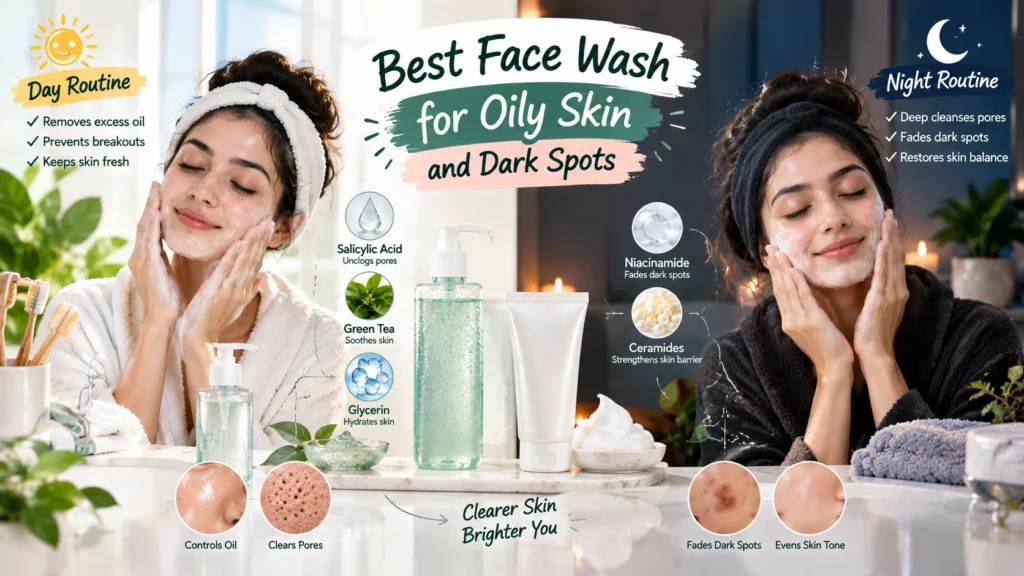
Simple Evening Routine
- Cleanser
- Appropriate treatment if needed
- Moisturizer
Ingredients such as azelaic acid, niacinamide, and retinoids may be used for post-acne marks depending on individual skin needs and tolerance.
Most importantly, avoid picking acne and protect your skin from UV exposure. Dark marks can take time to fade.
Best Face Wash for Oily and Sensitive Skin
Yes, your skin can be both oily and sensitive.
If your face becomes red, itchy, burning, or uncomfortable after cleansing, don’t assume that a stronger cleanser is the answer.
Look for a simple, gentle formula.
| ✅ Consider | ⚠️ Use Caution With |
|---|---|
| Fragrance-free formulas | Fragrance if it irritates your skin |
| Gentle cleansing agents | Very harsh cleansers |
| Glycerin | Excessively drying formulas |
| Ceramides | Frequent strong exfoliation |
| Niacinamide | Essential oils if they cause irritation |
You don’t automatically need to avoid every product containing sulfates or alcohol. What matters most is how the complete formulation works for your skin and whether it causes irritation or excessive dryness.
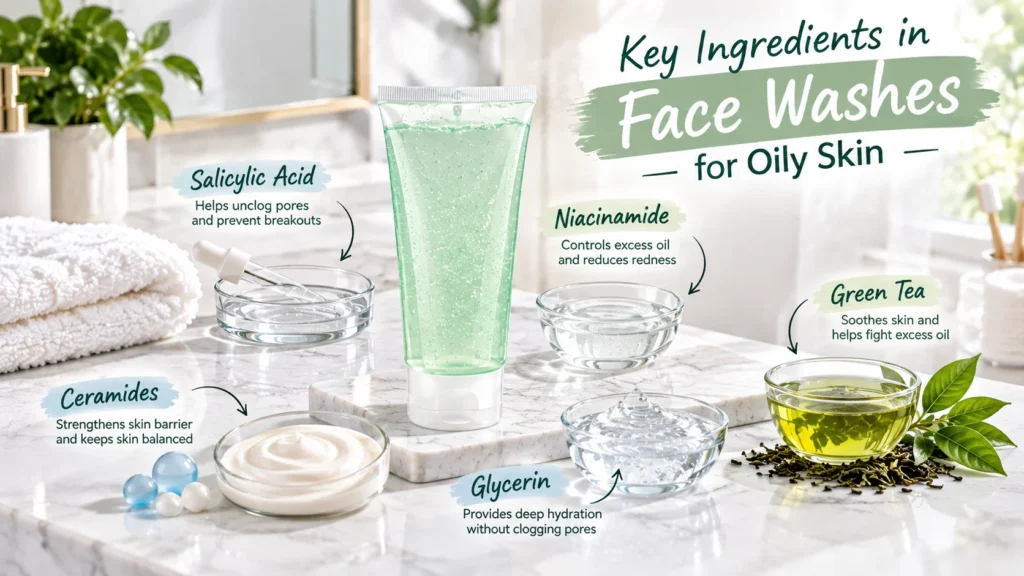
Key Ingredients in Face Washes for Oily Skin
Understanding ingredients can make choosing a cleanser much easier.
| Ingredient | Best For | What It Does |
|---|---|---|
| Salicylic Acid | Blackheads and clogged pores | Helps exfoliate inside pores |
| Benzoyl Peroxide | Inflamed acne | Helps reduce acne-causing C. acnes and inflammation |
| Niacinamide | Oiliness and barrier support | Can help regulate visible oiliness and support the skin barrier |
| Ceramides | Sensitive or irritated skin | Help support the skin barrier |
| Glycerin | Dehydrated skin | Helps attract and retain moisture |
| Hyaluronic Acid | Dehydrated oily skin | Helps attract and retain water |
| Green Tea Extract | Sensitive or acne-prone skin | Provides antioxidant and soothing properties |
| Tea Tree Oil | Some mild acne concerns | May help in properly formulated products but can irritate some skin |
Salicylic Acid
Salicylic acid is one of the most useful ingredients to look for if oily skin comes with blackheads or clogged pores.
It is a beta hydroxy acid (BHA) that can help exfoliate within pores.
If you’re new to salicylic acid, start gradually and reduce use if your skin becomes dry, irritated, or uncomfortable.
Benzoyl Peroxide
Benzoyl peroxide is particularly useful for inflammatory acne.
It can cause dryness and irritation, so use it carefully and follow with moisturizer.
It can also bleach fabrics, so be careful with towels, pillowcases, and clothing.
Niacinamide
Niacinamide is a form of vitamin B3 that can support the skin barrier and may help reduce the appearance of excess oil.
It’s generally well tolerated, although any skincare ingredient can potentially irritate sensitive skin.
Ceramides and Glycerin
These ingredients are especially useful when oily skin is also dehydrated or irritated.
A cleanser doesn’t need to leave your skin completely oil-free to be effective.
Gel vs. Foaming Cleansers: Which Is Better?
Both gel and foaming cleansers can work well for oily skin.
The formulation matters more than whether the cleanser produces foam.
Gel Cleansers
Pros:
- Lightweight texture
- Often comfortable for daily use
- Can work well for combination skin
- Many are formulated to be gentle
Best for: Oily, combination, or sensitive skin depending on the formulation.
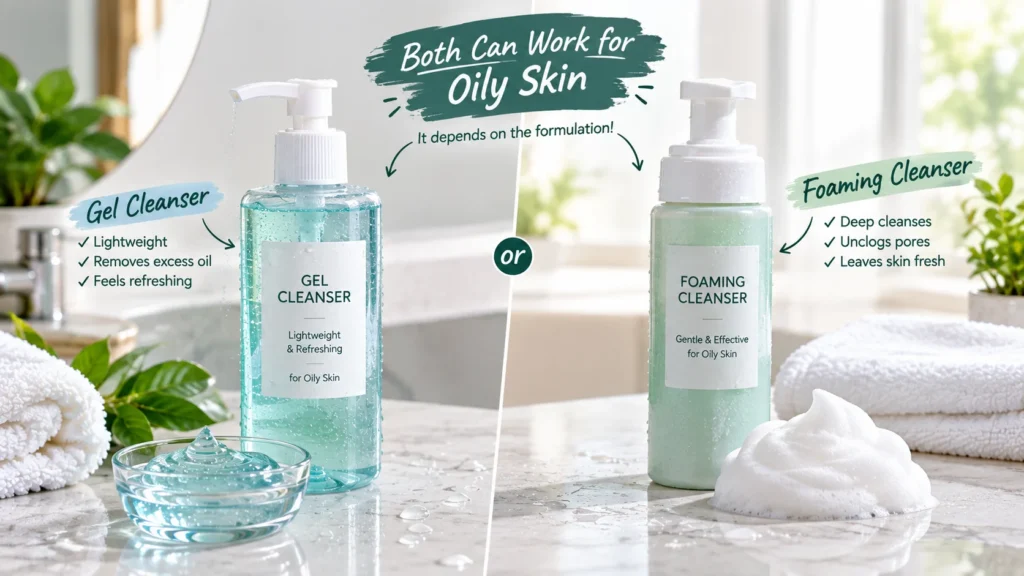
Foaming Cleansers
Pros:
- Remove excess oil effectively
- Rinse easily
- Can feel refreshing
- Useful for some people with very oily skin
Potential downside: Some formulas can be too drying or irritating.
The Key Point
It’s not the foam that determines whether a cleanser is good. The formulation does.
A gentle foaming cleanser can work beautifully, while a harsh gel cleanser can still irritate your skin.
Choose based on how your skin feels after cleansing—not how much foam you see.
How Often Should You Wash Oily Skin?
For many people, cleansing twice a day works well.
| Time | Purpose |
|---|---|
| Morning | Removes overnight oil and sweat |
| Evening | Removes sunscreen, makeup, oil, and daily buildup |
| After heavy sweating | Cleanses sweat when needed |
However, there isn’t a universal requirement to wash exactly twice every day.
If your skin becomes dry, tight, or irritated, consider a gentler cleanser or reducing cleansing frequency.
What About After Exercise?
If you’ve been sweating heavily, washing your face afterward can help remove sweat, oil, and products from the skin.
You don’t need to scrub aggressively.
How to Control Facial Shine During the Day
If your face becomes oily only a few hours after washing, don’t keep cleansing repeatedly.
Instead, try:
- Blotting papers: Press gently instead of rubbing.
- Lightweight moisturizer: Don’t skip hydration simply because your skin is oily.
- Sunscreen formulated for oily skin: Look for a lightweight texture that feels comfortable.
- Non-comedogenic makeup: Helpful if makeup tends to clog your pores.
- Avoid touching your face: Frequent touching can transfer oil and dirt.
The goal isn’t to remove every trace of oil. Your skin naturally needs some sebum.
Signs Your Face Wash Is Too Harsh
Your skin can give you clues when a cleanser isn’t suitable.
| Symptom | What It May Indicate |
|---|---|
| Tightness after washing | Cleanser may be too drying |
| Burning or persistent stinging | Irritation |
| Redness | Sensitivity or irritation |
| Flaking or peeling | Excessive dryness or irritation |
| Rough, uncomfortable skin | Barrier disruption |
| Increased sensitivity | Routine may be too aggressive |
Don’t Chase the “Squeaky Clean” Feeling
A cleanser doesn’t have to make your skin feel tight to prove that it worked.
Healthy-feeling skin should generally feel clean, comfortable, and not painfully stripped.
How to Use Face Wash Correctly
Even a good cleanser won’t help much if you’re using it incorrectly.
Step 1: Wet Your Face
Use lukewarm water rather than very hot water.
Step 2: Apply Cleanser
Use the amount recommended by the product. More cleanser isn’t necessarily better.
Step 3: Massage Gently
Use your fingertips and avoid aggressive scrubbing.
Step 4: Rinse Thoroughly
Make sure the cleanser is completely rinsed away.
Step 5: Pat Dry
Use a clean, soft towel and gently pat rather than rubbing your face.
Step 6: Moisturize
Apply a lightweight moisturizer after cleansing.
Step 7: Use Sunscreen in the Morning
Finish your morning routine with broad-spectrum sunscreen.
Common Face-Washing Mistakes to Avoid
1. Washing Too Frequently
Repeated cleansing can cause dryness and irritation.
2. Using Very Hot Water
Hot water can make already-sensitive skin feel more irritated.
3. Scrubbing Hard
Physical scrubbing isn’t necessary for clean skin and can aggravate acne.
4. Skipping Moisturizer
Oily skin still needs hydration and barrier support.
5. Using Too Many Active Ingredients
Combining several exfoliating or acne-focused ingredients can increase irritation.
6. Changing Products Every Few Days
Give your routine enough time to assess whether it’s working, unless you develop significant irritation.
7. Using a Cleanser That Burns
Burning isn’t evidence that a product is “working.”
Quick Guide: Choose a Face Wash Based on Your Skin Concern
| Skin Concern | Cleanser Type | Ingredients to Consider |
|---|---|---|
| Oily skin | Gentle gel or foaming cleanser | Niacinamide, glycerin |
| Oily + blackheads | Salicylic acid cleanser | Salicylic acid |
| Oily + acne | Gentle or acne-focused cleanser | Salicylic acid or benzoyl peroxide |
| Oily + pimples | Gentle cleanser + targeted treatment | Salicylic acid or benzoyl peroxide |
| Large-looking pores | Gentle pore-cleansing formula | Salicylic acid |
| Dark spots after acne | Gentle cleanser | Niacinamide; other treatments may be needed |
| Oily + sensitive | Fragrance-free gentle cleanser | Glycerin, ceramides |
| Oily but dehydrated | Hydrating gentle cleanser | Glycerin, hyaluronic acid, ceramides |
Best Face Wash for Oily Skin for Men and Women
You don’t need a completely different face wash because you’re a man or a woman.
Skin type and skin concerns matter more than gender.
A man with oily, acne-prone skin may benefit from the same types of ingredients as a woman with oily, acne-prone skin.
When choosing a cleanser, consider:
- How oily your skin is
- Whether you have acne
- Whether you have blackheads
- Whether your skin is sensitive
- Whether your skin feels dry after washing
- Whether you use sunscreen or makeup
Choose the formula—not the label.
Should You Use a Medicated Face Wash for Oily Skin?
Not necessarily.
A medicated or acne-focused cleanser can be useful if you’re dealing with acne, clogged pores, or frequent breakouts. But if your only concern is excess shine, a gentle cleanser may be enough.
For example:
- Salicylic acid: Often useful for clogged pores and blackheads
- Benzoyl peroxide: More appropriate for inflammatory acne
- Gentle cleanser: Often sufficient for uncomplicated oily skin
If an acne cleanser causes significant dryness or irritation, don’t assume that stronger is better.
Is Double Cleansing Necessary for Oily Skin?
Not everyone needs to double cleanse.
If you wear heavy makeup, water-resistant sunscreen, or products that are difficult to remove with one cleanser, double cleansing may be useful.
A simple approach is:
- Use an appropriate first cleanser or makeup/sunscreen remover.
- Follow with your regular gentle face wash.
If you’re not wearing makeup or heavy, water-resistant products, one effective cleanse may be enough.
Best Face Wash for Oily Skin in Pakistan and India
People searching for the best face wash for oily skin in Pakistan or India may notice that hot and humid weather can make facial oiliness feel more noticeable.
However, location alone shouldn’t determine which cleanser you buy.
In Hot or Humid Weather
You may prefer:
- Lightweight gel cleansers
- Non-greasy moisturizers
- Comfortable sunscreen
- Products that don’t leave a heavy residue
In Dry or Cool Weather
You may prefer:
- A gentler cleanser
- More hydrating skincare
- Less frequent use of strong active cleansers if irritation develops
Whether you’re looking for the best face wash for oily skin in Pakistan, the best face wash for oily skin in India, or simply a cleanser for oily skin anywhere else, focus on the formulation and your individual skin needs.
Price and popularity don’t automatically make a cleanser better.
When Should You See a Dermatologist?
A face wash can help with everyday oiliness and mild skincare concerns, but persistent or severe acne may require professional treatment.
Consider seeing a dermatologist if you have:
- Deep or painful acne
- Acne that is leaving scars
- Frequent severe breakouts
- Persistent redness or inflammation
- Significant irritation from skincare products
- Acne that isn’t improving with appropriate over-the-counter care
- Sudden or unusual changes in your skin
A dermatologist can determine whether you need treatments such as prescription retinoids, other topical medications, oral medications, or procedures.
Don’t rely on a face wash alone if your acne is painful, severe, or scarring.
Frequently Asked Questions
What’s the best face wash for oily skin?
There isn’t one universal best face wash. For basic oily skin, start with a gentle gel or foaming cleanser. If you also have blackheads or clogged pores, a salicylic acid cleanser may be useful.
What’s the best face wash for oily skin and acne?
For oily skin with acne, look for ingredients such as salicylic acid or benzoyl peroxide depending on the type of breakouts you’re experiencing. Start gradually and moisturize afterward to reduce dryness.
What’s the best face wash for oily skin and blackheads?
A salicylic acid cleanser can be a good option because salicylic acid helps exfoliate inside clogged pores. Use it according to the product instructions and reduce frequency if your skin becomes irritated.
What’s the best face wash for oily and sensitive skin?
Choose a gentle, fragrance-free cleanser that doesn’t leave your skin tight or burning. Ingredients such as glycerin and ceramides can be useful for supporting comfortable, hydrated skin.
Can face wash permanently shrink pores?
No. A cleanser cannot permanently change pore size. However, keeping pores clear and managing excess oil can make them appear less noticeable.
Is a medicated face wash always better?
No. Medicated cleansers can be helpful for acne and clogged pores, but they aren’t necessary for everyone with oily skin. A gentle cleanser may be a better choice if oiliness is your only concern.
Can men and women use the same face wash?
Yes. Skin type and skin concerns are more important than gender. A cleanser suitable for oily, acne-prone skin can generally be used regardless of whether the product is marketed toward men or women.
Should I wash my face twice a day if I have very oily skin?
Many people with oily skin do well with morning and evening cleansing. If your skin becomes dry, tight, or irritated, switch to a gentler formula or consider cleansing less frequently.
What if my face feels very dry after cleansing?
Your cleanser may be too drying for your skin. Try a gentler, hydrating formula and use a lightweight moisturizer after washing. If irritation persists, stop the product and consider professional advice.
How long should I try a new cleanser?
Give a new cleanser reasonable time to assess how your skin tolerates it, but don’t continue using a product that causes significant burning, swelling, or persistent irritation. Acne treatments may take longer to show noticeable improvement than simple cleansing.
Does climate affect oily skin?
Yes. Hot or humid conditions can make skin feel oilier, while cold or dry weather can increase dryness and sensitivity. Your cleanser may need to change with your skin’s needs throughout the year.
What pH should a face wash have?
Rather than focusing on one exact number, choose a cleanser formulated to be gentle and compatible with the skin barrier. Mildly acidic formulations are generally preferred over highly alkaline soaps.
A Simple Routine for Oily Skin
You don’t need a complicated 10-step routine.
Morning
Cleanser → Lightweight moisturizer → Broad-spectrum SPF 30+
Evening
Cleanser → Acne treatment if needed → Moisturizer
If your skin is sensitive or you’re new to active ingredients, introduce treatments gradually rather than adding several at once.
Your Simple Action Plan
1. Identify Your Main Concern
Is it:
- Oiliness?
- Blackheads?
- Pimples?
- Acne?
- Large-looking pores?
- Sensitivity?
2. Start With the Gentlest Suitable Cleanser
Don’t choose the strongest formula simply because your skin is oily.
3. Add Active Ingredients Only When Needed
Salicylic acid may help clogged pores, while benzoyl peroxide may be useful for inflammatory acne.
4. Moisturize
Oily skin still benefits from hydration and barrier support.
5. Protect Your Skin
Use sunscreen during daytime, especially when you’ll be exposed to sunlight.
6. Monitor Your Skin
If you experience persistent burning, redness, peeling, or worsening irritation, reassess your routine.
The Bottom Line
The best face wash for oily skin isn’t necessarily the most expensive, strongest, or most popular cleanser.
It’s the one that:
- Removes excess oil effectively
- Cleans without excessive dryness
- Matches your skin concerns
- Doesn’t cause persistent irritation
- Fits comfortably into your daily routine
If your main concern is oiliness, start with a gentle cleanser. If you’re dealing with blackheads or clogged pores, consider salicylic acid. If you have inflammatory acne, benzoyl peroxide may be more appropriate.
And remember: your skin doesn’t need to feel stripped to be clean.
A balanced routine—cleanser, moisturizer, and daytime sun protection—can be a much better long-term strategy than repeatedly trying to remove every trace of oil.
Healthy-looking skin isn’t built overnight. Consistency matters more than chasing the strongest product on the shelf. 🌿

Hannah Collins is a skincare writer focused on simple routines, trusted ingredient research, and practical advice for healthy, glowing skin.