Cystic acne is one of the most severe forms of acne. Unlike surface-level pimples, it causes deep, inflamed lesions that form beneath the skin. These lesions include inflammatory nodules (firm, painful lumps without fluid) and cyst-like lesions (larger, softer, and potentially fluid-filled). Both types are painful and carry a significantly higher risk of permanent scarring than typical breakouts.
How to Recognize It
A cystic acne lesion often feels like:
- A tender, painful lump beneath the skin
- Firm or swollen to the touch
- Deep-set, with no visible “head” or white tip
- Red and inflamed, sometimes warm to the touch
Common Locations
These breakouts tend to appear where oil glands are most active:
| Area | Why It Happens |
|---|---|
| Face (cheeks, T-zone) | High concentration of sebaceous glands |
| Chin and jawline | Hormone-sensitive areas |
| Chest and back | Many oil glands, friction from clothing |
| Shoulders and neck | Sweat and friction can contribute |
What Causes Cystic Acne?
The Hormonal Connection
During puberty, the body produces higher levels of androgens—hormones that stimulate oil glands to produce more sebum. When excess oil mixes with dead skin cells, pores become clogged. The bacterium Cutibacterium acnes (formerly Propionibacterium acnes) can then multiply within these clogged pores, triggering inflammation and leading to deep, painful lesions.
Contributing Factors
| Factor | Role in Cystic Acne |
|---|---|
| Hormonal changes | Primary driver during puberty; also affects adults |
| Genetics | If a close relative had severe acne, you’re more susceptible |
| Oily skin | Higher sebum production increases clogged pore risk |
| Skincare and makeup | Comedogenic (pore-clogging) products can worsen breakouts |
| Stress | Can trigger hormonal fluctuations that aggravate acne |
| Medications | Some drugs, including corticosteroids and lithium, may contribute |
What Doesn’t Cause Cystic Acne
| Myth | Reality |
|---|---|
| “Dirty skin causes acne” | Acne isn’t caused by poor hygiene; over-washing can make it worse |
| “Chocolate and greasy food cause breakouts” | Diet may play a minor role for some, but it doesn’t directly cause acne |
| “You just need to wash more” | Cystic acne is hormonal and genetic—not a hygiene issue |
Hormonal Acne: What to Look For
Hormonal acne has distinct patterns that can help identify it—though only a dermatologist can provide a definitive diagnosis.
Typical Signs
- Deep, painful bumps concentrated on the lower face
- Breakouts along the chin, jawline, and lower cheeks
- Recurring lesions in the same spots, especially around menstruation
- Cysts that feel tender, swollen, and inflamed
Patterns by Gender
| Feature | Females | Males |
|---|---|---|
| Timing | Often flares with menstrual cycle | More consistent, less cyclical |
| Location | Lower face, chin, jawline | Face, chest, back |
| Persistence | Can continue into adulthood | Typically peaks in late teens |
⚠️ Important: Online images cannot diagnose your specific skin condition. Many issues—including folliculitis, skin cysts, and allergic reactions—can resemble cystic acne. Only a dermatologist can determine what you’re dealing with.
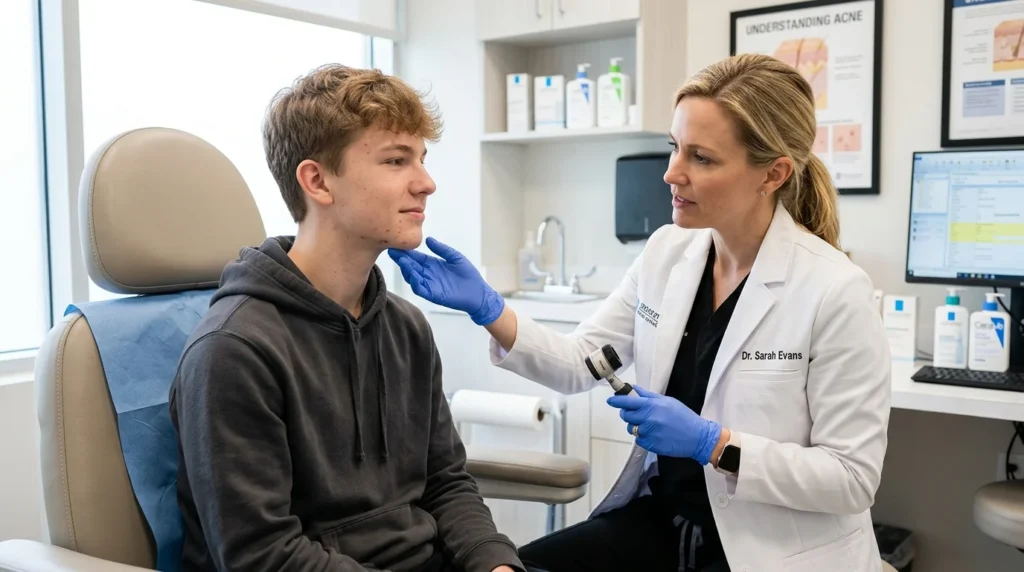
Treatment: Why Cystic Acne Needs Professional Care
The Most Important First Step
🔑 If you have cystic acne, your first step should be seeing a dermatologist. While over-the-counter products can help with mild-to-moderate acne, deep cystic lesions almost always require prescription-strength treatment to prevent permanent scarring.
Why OTC Products Aren’t Enough
| Treatment | Effectiveness for Mild Acne | Effectiveness for Cystic Acne |
|---|---|---|
| Benzoyl peroxide | ✅ Can be effective | ⚠️ May help as part of a regimen, but rarely sufficient alone |
| Salicylic acid | ✅ Good for clogged pores | ❌ Too mild for deep cystic lesions |
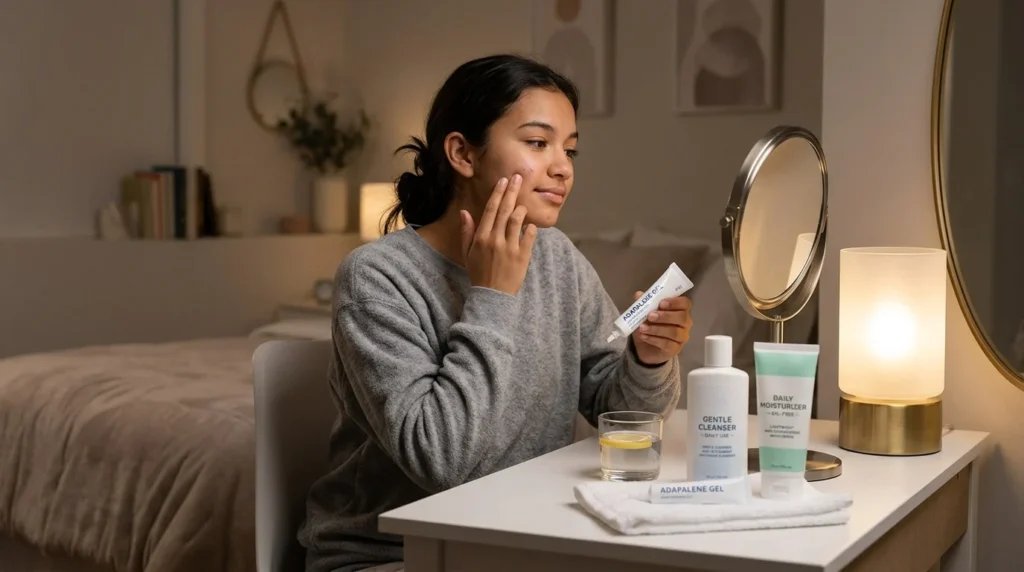
| Adapalene | ✅ Effective for mild-moderate acne | ⚠️ OTC strength may be insufficient; prescription retinoids are often needed for cystic acne |
| Tea tree oil | ⚠️ Limited evidence | ❌ Not strong enough for cystic acne |
💡 Bottom line: OTC treatments are designed for mild-to-moderate acne. Cystic acne requires professional care. Don’t spend months trying OTC products on deep cysts—see a dermatologist early to prevent scarring.
Prescription Options a Dermatologist May Recommend
| Treatment | How It Works | Used For |
|---|---|---|
| Topical retinoids (tretinoin, tazarotene, adapalene) | Unclog pores, prevent new lesions | Moderate to severe acne |
| Topical antibiotics (clindamycin, erythromycin) | Reduce C. acnes bacteria and inflammation | Inflammatory acne |
| Oral antibiotics (doxycycline, minocycline) | Reduce inflammation throughout the body | Widespread inflammatory acne |
| Combination therapy | Antibiotic + retinoid or benzoyl peroxide | Enhanced effectiveness; reduces antibiotic resistance risk |
| Hormonal therapy (birth control, spironolactone) | Regulate hormones (females) | Hormonal acne |
| Corticosteroid injections | Rapidly shrink painful cysts | Individual severe lesions |
| Isotretinoin (Accutane) | Powerful systemic treatment | Severe, scarring, treatment-resistant acne |
⚠️ Important Antibiotic Warning
Antibiotics (topical or oral) should never be used alone for acne treatment. They are most effective when combined with benzoyl peroxide or a retinoid. Using antibiotics alone increases the risk of bacterial resistance, making future acne harder to treat. Always follow your dermatologist’s guidance on combination therapy.
⚠️ Never start prescription acne treatments without medical supervision. These require proper dosing, monitoring, and awareness of potential side effects.
Treatment Considerations for Teenage Girls
There isn’t a single “best” treatment for every teenage girl—the right approach depends on individual factors.
Factors That Guide Treatment Choice
| Factor | What to Consider |
|---|---|
| Severity | Mild vs. moderate vs. severe cystic acne |
| Acne type | Clogged pores vs. deep inflammation |
| Skin sensitivity | Dry or sensitive skin may need gentler options |
| Scarring | Whether scars are already forming |
| Hormonal patterns | Menstrual cycle, possible PCOS |
| Previous treatments | What has or hasn’t worked |
Typical Treatment Pathways
| Acne Level | Recommended Approach |
|---|---|
| Mild | OTC benzoyl peroxide or salicylic acid + gentle skincare |
| Moderate | Prescription retinoid + benzoyl peroxide or topical antibiotic |
| Moderate with hormonal pattern | Topical treatment + hormonal therapy |
| Severe cystic | Dermatologist-directed regimen, possibly including isotretinoin |
| With scarring | Early retinoid treatment + professional scar management |
OTC Ingredients: Their Role and Realistic Limitations
If you’re wondering which over-the-counter treatments exist, here are the most common options—along with their limitations.
1. Benzoyl Peroxide
| Aspect | Details |
|---|---|
| Best for | Mild-to-moderate inflammatory acne |
| Available | OTC in 2.5%, 5%, and 10% strengths |
| How it works | Kills C. acnes bacteria, reduces inflammation |
| Pro tip | 2.5% is as effective as 10% with less irritation |
| Limitation for cystic acne | May help as part of a regimen but rarely works alone |
2. Salicylic Acid
| Aspect | Details |
|---|---|
| Best for | Clogged pores, blackheads, whiteheads |
| Available | OTC in cleansers, toners, spot treatments |
| How it works | Exfoliates inside pores, prevents clogging |
| Pro tip | Can be drying—always follow with moisturizer |
| Limitation for cystic acne | Too mild to treat deep cystic lesions |
3. Adapalene (Differin Gel)
| Aspect | Details |
|---|---|
| Best for | Mild-to-moderate acne |
| Available | OTC (0.1%) and prescription (0.3%) |
| How it works | Retinoid that regulates skin cell turnover, unclogs pores |
| Pro tip | Some people experience temporary worsening of acne (often called “purging”) in the first few weeks as deeper lesions come to the surface. This is not guaranteed and varies by individual. |
| Limitation for cystic acne | OTC strength (0.1%) may be insufficient for cystic acne; prescription-strength retinoids (0.3% adapalene, tretinoin, or tazarotene) are often needed |
The Bottom Line on OTC Products
✅ Use OTC treatments for mild acne or as directed by a dermatologist for cystic acne.
❌ Do not rely on OTC products alone for cystic acne. Delaying professional care increases scarring risk.
At-Home Care: What Helps and What Hurts
Safe At-Home Practices
| Practice | Why It Helps |
|---|---|
| Gentle cleansing twice daily | Removes excess oil without stripping skin |
| Non-comedogenic products | Prevents additional pore-clogging |
| Showering after exercise | Removes sweat and bacteria |
| Changing pillowcases regularly | May help reduce bacterial exposure |
| Adequate sleep | Supports overall skin health and stress reduction |
| Stress management | May help reduce hormonal flares |
| Balanced diet | Supports overall health |
Morning Routine ☀️
| Step | Product | Why |
|---|---|---|
| 1 | Gentle cleanser | Remove overnight oil |
| 2 | Acne treatment (if directed) | Apply prescribed or recommended product |
| 3 | Non-comedogenic moisturizer | Protect skin barrier |
| 4 | SPF 30+ sunscreen | Prevent dark marks |
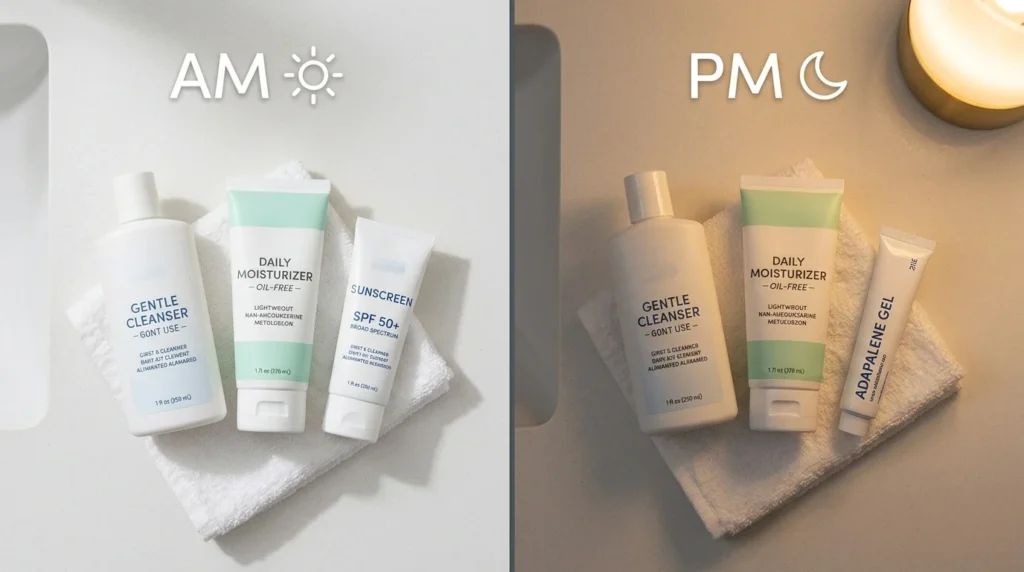
Evening Routine 🌙
| Step | Product | Why |
|---|---|---|
| 1 | Gentle cleanser | Remove makeup, sunscreen, daily buildup |
| 2 | Acne treatment (if directed) | Prescribed retinoids or other actives |
| 3 | Moisturizer | Support overnight repair |
Practices to Avoid
| Practice | Why It’s Harmful |
|---|---|
| Lemon juice | Can cause chemical burns and increase UV sensitivity |
| Toothpaste | Contains irritating ingredients; doesn’t treat acne |
| Baking soda | Too alkaline; damages skin barrier |
| Harsh scrubs | Can rupture cysts and worsen inflammation |
| Apple cider vinegar | Can cause burns and irritation |
| Undiluted essential oils | Many cause contact dermatitis |
💡 Start new products slowly—introduce one at a time every 2-3 days. If your skin becomes very dry, irritated, or painful, reduce use and consult a healthcare professional.
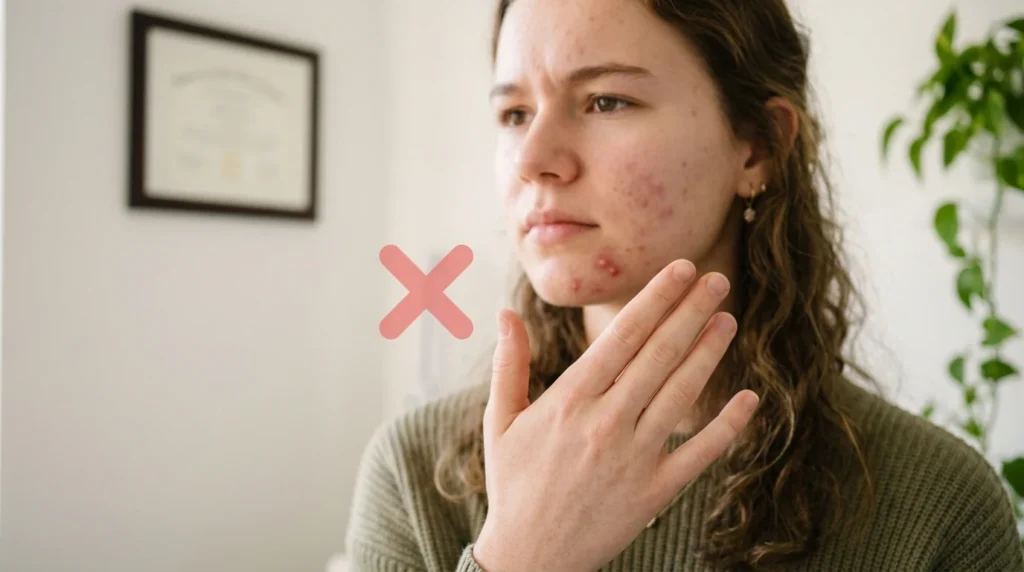
The Number One Rule: Never Pop or Squeeze
This rule is critical for anyone with cystic acne.
Why Cysts Are Different
A cystic lesion is not like a superficial whitehead. It doesn’t have a contained “head” that can be safely extracted. Attempting to drain it yourself:
- Worsens inflammation
- Damages surrounding tissue
- Dramatically increases scarring risk
- Can lead to infection
What Happens When You Pick
| Immediate Effect | Short-Term Consequence | Long-Term Result |
|---|---|---|
| Increased pain | Infection risk rises | Permanent scars |
| Worsened redness | Healing time extends | Dark marks become more noticeable |
| Spread of inflammation | More cysts may form | Uneven skin texture |
What to Do Instead
- Leave it alone—don’t touch or squeeze
- Apply ice (10 minutes on, 20 minutes off, wrapped in a cloth) to reduce swelling
- Follow your treatment plan consistently
- See a dermatologist for professional treatment
The Reality About Overnight Cures
There is no reliable way to eliminate a cystic pimple overnight. Anyone claiming otherwise is misleading you.
Why Quick Fixes Don’t Work
| Reason | Explanation |
|---|---|
| Depth of the lesion | Forms deep in the dermis, not on the surface |
| Nature of inflammation | Typically takes days to weeks to resolve |
| Risk of forcing it | Squeezing worsens inflammation and damages tissue |
What Can Help
- ✅ Ice applied for 10 minutes (on/off) to reduce swelling
- ✅ Continuing your prescribed treatment
- ✅ A hydrocolloid patch—can protect from touching, but cannot treat a deep cyst
When a Doctor Can Help Faster
A dermatologist can use corticosteroid injections to rapidly reduce the size and pain of an individual cyst. This is a professional procedure—never attempt this at home.
Healing Stages and What to Expect
Typical Timeline
Healing times vary significantly from person to person, but a general pattern might look like:
What to Expect at Each Stage
| Stage | Approximate Duration | What’s Happening | What to Do |
|---|---|---|---|
| Active cyst | 1-3 weeks | Inflammation, pain, swelling | Don’t touch; follow treatment |
| Resolving cyst | 2-4 weeks | Slowly flattening; less pain | Continue routine; be patient |
| Healed but discolored | 3+ months | Pink, red, brown, or dark mark | Sunscreen; consult dermatologist about fading treatments |
Post-Acne Marks
| Type | Appearance | How to Help It Fade |
|---|---|---|
| PIE (red/pink marks) | Red or pink spots | Sunscreen, time, vitamin C, niacinamide |
| PIH (brown/dark marks) | Brown or dark spots | Sunscreen, time, azelaic acid, prescription treatments |
Diet and Cystic Acne
What Research Shows
| Dietary Factor | Evidence | Recommendation |
|---|---|---|
| High-glycemic foods | Moderate evidence may worsen acne | Consider reducing sugary foods, refined carbs |
| Dairy | Mixed/weak evidence | Some may benefit from reducing intake |
| Saturated fats | Limited evidence | General health recommendation |
| Anti-inflammatory foods | Limited but promising | Include fruits, vegetables, omega-3s |
Healthy Eating Guidelines
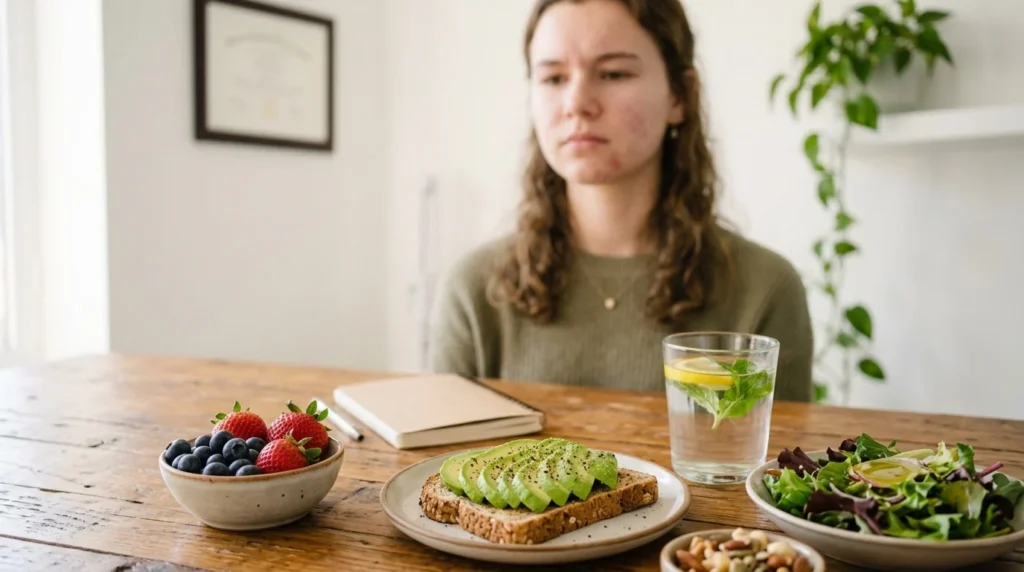
Instead of eliminating entire food groups, focus on:
| Food Group | Examples |
|---|---|
| Vegetables | Leafy greens, bell peppers, broccoli |
| Fruits | Berries, apples, oranges |
| Whole grains | Brown rice, oats, quinoa |
| Lean proteins | Chicken, fish, legumes |
| Healthy fats | Avocado, olive oil, nuts |
If You Suspect Food Triggers
- Keep a food diary for 2-3 weeks
- Note what you eat and your skin’s condition
- Look for patterns
- Discuss with a healthcare professional before making major changes
🔬 Remember: Diet is a small piece of the puzzle. Even with perfect nutrition, cystic acne usually requires medical treatment.
A Simple Routine for a 14-Year-Old
Morning
- Gentle cleanser
- Moisturizer (if needed)
- SPF 30+ sunscreen
Evening
- Gentle cleanser
- Appropriate acne treatment (as recommended)
- Moisturizer
What a Young Teen Doesn’t Need
- ❌ Complicated multi-step routines
- ❌ Professional-strength products without supervision
- ❌ Multiple active ingredients
- ❌ Constant product switching
- ❌ Harsh scrubs or physical exfoliants
When to Involve Parents
If acne is:
- Deep and painful
- Widespread
- Not responding to OTC treatment
- Leaving scars
- Affecting confidence or mental health
A parent or guardian should help arrange a dermatologist appointment.
When to See a Dermatologist
Red Flags
| Sign | Why It Matters |
|---|---|
| Deep, painful pimples | High risk of scarring |
| Acne leaving scars or dark marks | Permanent damage is possible |
| Breakouts keep returning | May require prescription treatment |
| Large areas affected | Could indicate systemic factors |
| OTC treatment not helping | Professional treatment needed |
| Acne affecting emotional wellbeing | Mental health matters |
| Uncertain if it’s actually acne | Other conditions need different treatment |
Why Early Treatment Matters
| Without Early Treatment | With Early Treatment |
|---|---|
| Higher scarring risk | Lower scarring risk |
| Longer treatment time | Shorter, more effective treatment |
| More emotional distress | Better quality of life |
| Harder to treat later | Easier to manage early |
💙 Remember: Seeking help for acne is healthcare, not vanity. Cystic acne is a medical condition that deserves proper treatment.
Scarring: Prevention and Management
Types of Acne Scars
| Type | Appearance | Professional Treatment Options |
|---|---|---|
| Depressed scars | Indentations in skin | Lasers, microneedling, fillers |
| Raised scars | Thick, raised tissue | Injections, laser, surgery |
| Dark marks (PIH) | Brown spots | Sunscreen, fading treatments |
| Red marks (PIE) | Red or pink spots | Sunscreen, time, anti-inflammatory products |
Prevention Is Key
The best time to prevent scars is while the acne is active.
| Strategy | How It Helps |
|---|---|
| Don’t pick or squeeze | Prevents tissue damage |
| Start treatment early | Reduces inflammation before scarring occurs |
| Use sunscreen daily | Prevents dark marks from darkening |
| Follow treatment consistently | Gets acne under control faster |
| See a dermatologist | Professional care reduces scar risk |
Frequently Asked Questions
Does cystic acne require prescription treatment?
In most cases, yes. Cystic acne is a severe form of acne that typically requires prescription-strength treatment. OTC products are rarely sufficient for deep cystic lesions. See a dermatologist for proper evaluation and treatment.
What can I do about a painful cyst right now?
- Don’t squeeze or pop it—this will worsen inflammation and increase scarring risk
- Apply ice (10 minutes on, 20 minutes off, wrapped in a cloth) to reduce swelling
- Continue your treatment routine
- See a dermatologist for professional treatment, including possible corticosteroid injections for rapid relief
Can hormones cause cystic acne?
Yes. Hormonal changes, particularly during puberty, are a primary driver of cystic acne. Androgens stimulate oil production, leading to clogged pores and inflammation. Genetics and other factors also play a role.
What are the best treatments for teenage cystic acne?
The best treatment depends on severity and individual factors. Common approaches include:
- Prescription retinoids
- Topical or oral antibiotics (always combined with benzoyl peroxide or a retinoid)
- Hormonal therapy (for females)
- Isotretinoin for severe cases
A dermatologist can recommend what’s right for you.
Is there a natural cure for cystic acne?
There is no proven natural cure for cystic acne. While healthy habits—gentle cleansing, adequate sleep, stress management, and a balanced diet—support overall skin health, severe cystic acne almost always requires medical treatment to prevent scarring.
How long does cystic acne take to heal?
Healing varies by individual:
- Active lesion: 1-3 weeks
- Complete inflammation resolution: 2-6 weeks
- Fading of marks: 3 months or longer
With professional treatment, the active phase can be shortened and scarring risk reduced.
Will cystic acne go away without treatment?
Cystic acne often persists or worsens without proper treatment. While individual lesions may eventually heal, new ones frequently continue to appear without effective management. Without treatment, the risk of scarring increases significantly. Early professional care offers the best outcomes.
Final Thoughts
Cystic acne can be painful, frustrating, and emotionally challenging. But having severe acne doesn’t mean you have to simply wait for it to disappear.
Key Takeaways
| Principle | Why It’s Important |
|---|---|
| Don’t pick | Prevents scarring and tissue damage |
| See a dermatologist early | Best chance for clear skin without scars |
| Be patient | Treatment results typically take 8-12 weeks |
| Use sunscreen daily | Prevents dark marks |
| Keep it simple | More products don’t mean better results |
| Follow treatment consistently | Consistency is key to success |
You’re Not Alone
💙 Acne affects up to 85% of teenagers. It’s one of the most common skin conditions in the world. Having cystic acne doesn’t mean you’re doing something wrong—it means you have a skin condition that requires proper medical care.
Don’t waste time trying to force deep pimples away overnight. Cystic acne develops beneath the skin, and aggressive DIY treatments often cause more damage than the original breakout.
With the right treatment, patience, and professional guidance, teenagers can effectively manage cystic acne and reduce the risk of long-term scarring. Your skin can heal—and with it, your confidence can grow.
Quick Reference: Do’s and Don’ts
| ✅ DO | ❌ DON’T |
|---|---|
| See a dermatologist early | Pop or squeeze cysts |
| Use gentle cleansers | Use harsh physical scrubs |
| Apply non-comedogenic moisturizer | Over-wash your face |
| Wear SPF 30+ daily | Combine multiple strong actives without guidance |
| Be patient (8-12 weeks for results) | Try lemon juice, toothpaste, or baking soda |
| Use one new product at a time | Rely on OTC products alone for cystic acne |
| Follow your treatment consistently | Use antibiotics alone (without benzoyl peroxide or a retinoid) |
| Trust your dermatologist’s guidance | Give up after just 2 weeks |
Medical Disclaimer
This article is for educational purposes only and does not replace professional medical advice. Severe, painful, or scarring acne should be evaluated by a dermatologist or qualified healthcare professional. If you are experiencing a medical emergency, seek immediate care.

Laura Bennett is a skincare writer dedicated to sharing practical skincare routines, ingredient knowledge, and healthy skin tips for every day.