Waking up to a new pimple can be frustrating, especially when it feels like one breakout is barely healing before another appears. If you’re wondering how to stop breakouts, there isn’t usually one miracle product that works for everyone. Acne can be influenced by excess oil, clogged pores, hormonal changes, inflammation, irritating products, friction, stress, and genetics.
The good news is that you can often reduce how frequently you break out by following a simple, consistent skincare routine and identifying habits or triggers that may be making your acne worse. You don’t need to scrub your skin repeatedly or use several harsh treatments at once.
This guide explains how to stop breakouts on your face, what to do when a sudden pimple appears, how to prevent breakouts in different areas, and when it may be time to see a dermatologist.
What Causes Frequent Breakouts?
Before learning how to stop breakouts before they start, it helps to understand why they happen.
Acne can develop when excess sebum and dead skin cells build up inside hair follicles. This can clog pores and contribute to inflammation. Hormonal changes, genetics, skincare products, friction, and other factors can also influence how often breakouts occur.
Common factors include:
- Hormonal changes
- Excess oil production
- Clogged pores
- Certain skincare, makeup, or hair products
- Picking or squeezing pimples
- Sweat and friction
- Stress
- Some medications
- Hormonal fluctuations around menstruation
- Shaving or waxing irritation
Not every breakout has the same cause. What triggers acne for one person may not affect another, so paying attention to your own patterns can be helpful.
How to Stop Breakouts on Face
If you’re asking, “How can I stop my face from breaking out?”, start with a few basic habits rather than immediately adding multiple products.
1. Wash Your Face Gently
Cleanse your face gently instead of scrubbing aggressively. Washing too often or using harsh cleansers can irritate the skin barrier and make your skin feel dry and uncomfortable.
A gentle cleanser is a good starting point. If you have oily skin or clogged pores, a cleanser containing salicylic acid may be helpful.
2. Don’t Pick Your Pimples
Squeezing and picking can increase inflammation and may increase the risk of post-acne marks and scarring.
If a pimple is painful, resist the temptation to force it out. Let it heal while following an appropriate acne treatment.
3. Choose Non-Comedogenic Products
Look for skincare and makeup labeled non-comedogenic, meaning they are formulated to be less likely to clog pores.
This can be especially useful if you notice breakouts after introducing a new moisturizer, sunscreen, makeup product, or hair product.
4. Keep Your Routine Simple
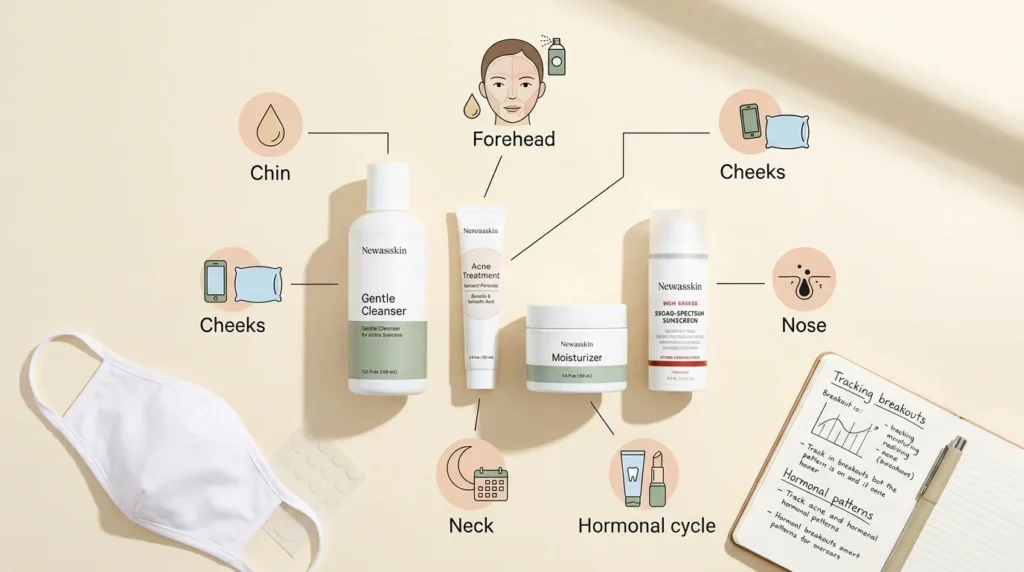
You don’t need several acne treatments at once. Using too many active ingredients can irritate your skin and make it difficult to determine which product is helping.
A simple routine can include:
Morning ☀️
- Gentle cleanser
- Suitable acne treatment, if needed
- Non-comedogenic moisturizer
- Broad-spectrum SPF 30+ sunscreen
Evening 🌙
- Gentle cleanser
- Appropriate acne treatment
- Moisturizer
Introduce new products gradually and give them enough time to work unless they cause significant irritation.
How to Treat a Sudden Face Breakout
When a sudden breakout appears, it’s natural to want to make it disappear immediately. However, there is no safe treatment that can reliably remove a pimple overnight or make it disappear within minutes.
Instead:
- Don’t squeeze or pick it.
- Keep the area clean.
- Use an appropriate acne treatment.
- Apply a wrapped cold compress briefly if swelling is uncomfortable.
- Avoid applying several strong products to the same area.
- Give your treatment time to work.
A hydrocolloid patch can protect a surface-level pimple from touching and picking. However, it won’t remove a deep cyst or cure acne overnight.
How to Stop Pimples Coming on Face at Home
If you’re looking for how to stop pimples coming on your face at home, focus on reducing avoidable irritation and keeping your routine consistent.
Helpful habits include:
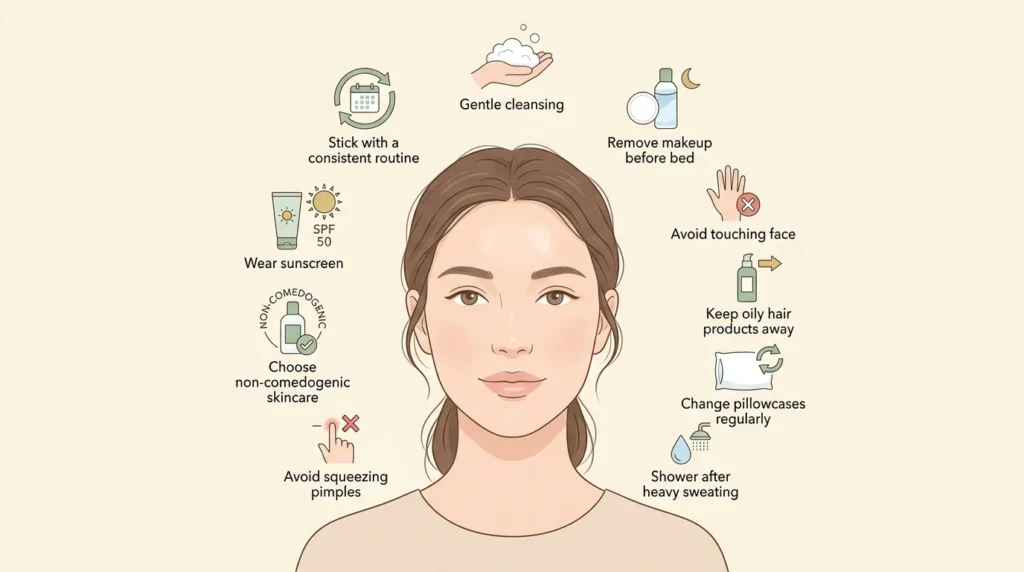
- Cleanse gently.
- Remove makeup before bed.
- Avoid touching your face unnecessarily.
- Keep oily hair products away from your facial skin.
- Change pillowcases regularly.
- Shower after heavy sweating.
- Avoid squeezing pimples.
- Choose non-comedogenic skincare.
- Wear sunscreen.
- Stick with a consistent routine.
These habits cannot guarantee completely clear skin, but they can help reduce some common contributors to breakouts.
How to Stop Breakouts Before Your Period
Hormonal fluctuations can cause acne to flare around menstruation. If you repeatedly notice pimples appearing before your period, keeping a simple cycle and breakout diary can help you recognize the pattern.
Continue your normal acne routine consistently rather than waiting until a breakout becomes noticeable.
If premenstrual acne is severe, painful, or persistent, talk with a dermatologist. Hormonal acne may require treatment beyond basic skincare.
How to Stop Breakouts During Your Period
Your skin does not necessarily need a completely different routine during your period.
Continue with:
- Gentle cleansing
- Appropriate acne treatment
- Moisturizing
- Sunscreen
- Avoiding picking
If your breakouts become consistently severe during your menstrual cycle, discuss the pattern with a healthcare professional.
How to Stop Breakouts on Chin
Breakouts around the chin and jawline are common and may sometimes be associated with hormonal changes.
To help manage them:
- Avoid resting your hands on your chin.
- Cleanse the area gently.
- Keep lip and facial products from spreading onto the surrounding skin.
- Avoid squeezing chin pimples.
- Track whether breakouts follow your menstrual cycle.
If chin acne repeatedly becomes deep or painful, professional treatment may be appropriate.
How to Stop Breakouts Around Mouth
The skin around the mouth can become irritated easily, so be cautious with acne treatments in this area.
Avoid applying harsh acne products directly to the lips or very sensitive skin around them unless a healthcare professional has advised you to do so.
You may also want to consider whether toothpaste, lip products, heavy makeup, or fragranced skincare seems to coincide with irritation.
If you develop a persistent rash-like breakout around the mouth, don’t automatically assume it is ordinary acne. Conditions such as perioral dermatitis can look similar and may require different treatment.
How to Stop Breakouts on Cheeks
Cheek breakouts can be related to acne, cosmetics, friction, or objects that regularly touch the skin.
Try:
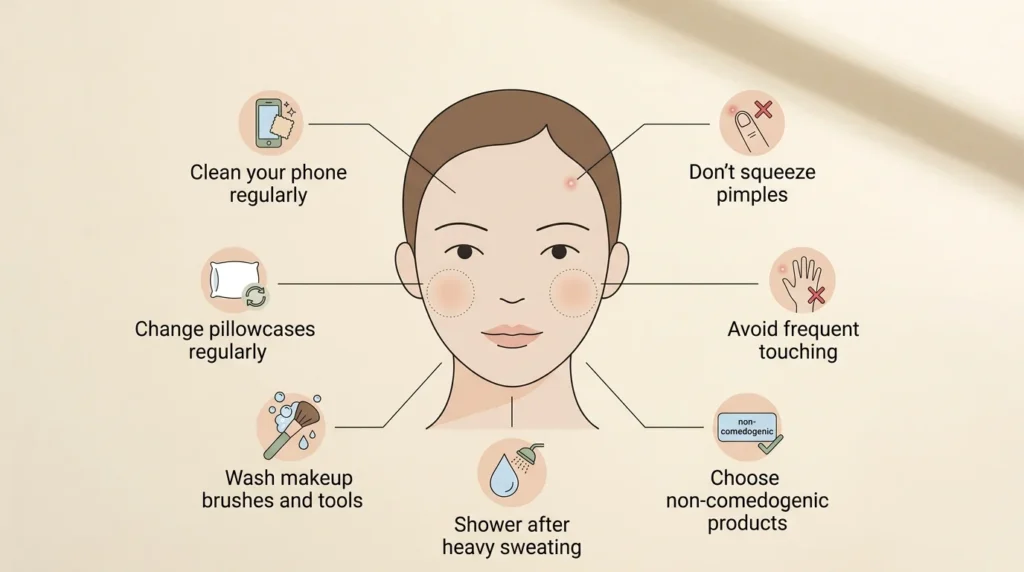
- Cleaning your phone regularly
- Changing pillowcases regularly
- Washing makeup brushes and tools
- Choosing non-comedogenic products
- Avoiding frequent touching
- Showering after heavy sweating
- Not squeezing pimples
If only one side of your face repeatedly breaks out, pay attention to what regularly touches that side, such as your phone, pillow, or hands.
How to Stop Breakouts on Forehead
Forehead acne can sometimes be associated with oil, sweat, hair products, and clogged pores.
If you’re dealing with forehead breakouts:
- Keep oily hair and styling products away from your forehead.
- Wash your face after heavy sweating.
- Use a gentle cleanser.
- Avoid thick products that may clog pores.
- Don’t scrub the forehead aggressively.
Persistent or unusual forehead bumps aren’t always acne, so consider seeing a dermatologist if they don’t improve.
How to Stop Breakouts on Nose
The nose contains many oil glands, so clogged pores and blackheads are common in this area.
A salicylic acid product may help loosen dead skin cells and reduce clogged pores.
Avoid squeezing blackheads or repeatedly using pore strips. Excessive irritation can damage the skin barrier and leave the area red or uncomfortable.
How to Stop Breakouts on Neck
Neck breakouts can be associated with sweat, friction, hair products, shaving, or acne.
To reduce irritation:
- Cleanse the neck gently.
- Shower after sweating.
- Keep hair products from sitting on the neck.
- Avoid tight collars when possible.
- Don’t pick the affected skin.
If bumps appear mainly after shaving, they may be related to irritation or ingrown hairs rather than traditional acne.
How to Stop Breakouts on Chest
Chest acne can be encouraged by sweat, friction, and tight clothing.
Helpful habits include:
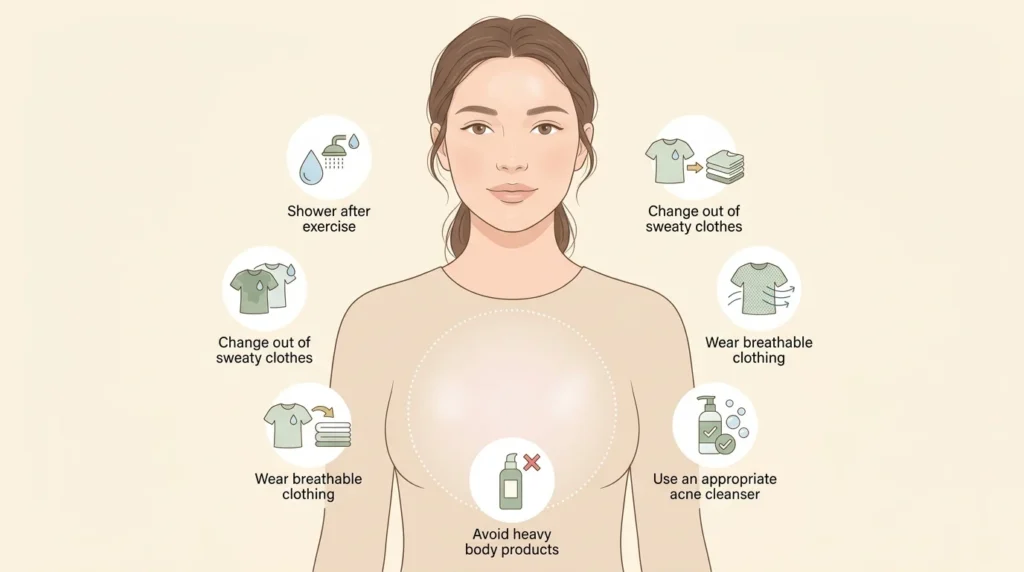
- Showering after exercise
- Changing out of sweaty clothes
- Wearing breathable clothing
- Avoiding heavy body products on acne-prone areas
- Using an appropriate acne cleanser if needed
Don’t scrub chest acne aggressively because friction can increase irritation.
How to Stop Breakouts on Back
Back acne, sometimes called “bacne,” can be difficult to reach but is often manageable.
Try:
- Showering after sweating
- Wearing clean, breathable clothing
- Washing your back gently
- Keeping oily hair products away from your back
- Avoiding tight backpacks or clothing when possible
- Using an acne treatment appropriate for body acne
If back acne is widespread, painful, or leaving scars, a dermatologist can recommend additional treatment.
How to Stop Breakouts After Shaving
Shaving can cause irritation, razor bumps, or ingrown hairs that may look similar to acne.
To reduce shaving-related bumps:
- Use a clean, sharp razor.
- Don’t shave dry skin.
- Use a gentle shaving product.
- Shave in the direction of hair growth when possible.
- Avoid repeatedly passing the razor over the same area.
- Don’t pick bumps afterward.
- Avoid shaving directly over painful, inflamed pimples when possible.
If shaving consistently causes painful or pus-filled bumps, talk with a healthcare professional. The problem may be folliculitis or ingrown hairs rather than acne.
How to Stop Breakouts After Waxing
Waxing can temporarily irritate the skin and may contribute to small bumps.
After waxing:
- Avoid unnecessary touching.
- Use gentle, fragrance-free skincare.
- Avoid harsh exfoliation immediately afterward.
- Avoid heavy products that may clog pores.
- Give irritated skin time to recover.
If you repeatedly develop acne-like bumps after waxing, discuss the problem with a dermatologist.
How to Stop Breakouts When Wearing a Mask
Masks can trap heat, moisture, oil, and friction against the skin. For some people, this can contribute to breakouts.
To reduce mask-related irritation:
- Wear a clean mask.
- Change disposable masks regularly.
- Wash reusable masks appropriately.
- Avoid heavy makeup underneath the mask.
- Cleanse gently after wearing one.
- Don’t scrub irritated areas.
How to Stop Breakouts From Mask Friction
Friction is one reason masks may worsen acne or irritation.
Make sure the mask fits comfortably without excessive rubbing. If your skin becomes irritated, simplify your routine and avoid harsh exfoliants until it settles.
Why Am I Breaking Out So Easily?
If you seem to break out from almost everything, don’t assume that your skin is simply “dirty.”
Frequent breakouts can have several possible contributors, including:
- Hormones
- Genetics
- Excess sebum
- Clogged pores
- Irritating skincare
- Hair products
- Friction
- Stress
- Certain medications
If acne keeps returning despite a consistent routine, a dermatologist can help determine what may be contributing to it.
Can You Permanently Stop Breakouts?
There isn’t a guaranteed way to permanently stop breakouts because acne can return, particularly when hormonal or genetic factors are involved.
A more realistic goal is long-term acne control.
This can involve:
- Identifying personal triggers
- Treating active acne
- Preventing clogged pores
- Following a consistent routine
- Avoiding picking
- Seeking professional treatment when necessary
If acne is severe, early treatment can also help reduce the risk of lasting scars.
Can You Cure Pimples Naturally in 3 Days?
Be cautious about claims that you can cure acne naturally in three days.
A pimple may become less swollen within a few days, but there is no proven natural method that permanently cures acne in three days.
Avoid harsh DIY treatments such as:
- Lemon juice
- Baking soda
- Toothpaste
- Undiluted vinegar
These substances can irritate the skin and may make redness or discoloration worse.
How to Treat Pimples Safely
Rather than searching for one miracle cure, think about long-term acne management.
Depending on the type and severity of acne, ingredients such as:
- Benzoyl peroxide
- Salicylic acid
- Adapalene
- Azelaic acid
may be useful.
The right treatment depends on factors such as your age, acne severity, skin sensitivity, and previous treatment history.
Prescription acne medications should only be used with appropriate medical guidance.
What Is the Best Medicine for Pimples?
There isn’t one best medicine for pimples for everyone.
For occasional mild acne, an over-the-counter treatment may be enough. More severe inflammatory, nodular, or cystic acne may require prescription treatment.
If your acne is deep, painful, widespread, or leaving scars, don’t keep trying increasingly strong products on your own. A healthcare professional can help you choose an appropriate treatment.
What Not to Do When Trying to Stop Breakouts
Some common acne habits can make breakouts worse.
Don’t Overwash
Washing repeatedly doesn’t remove acne from the root. It can instead cause dryness and irritation.
Don’t Scrub Aggressively
Physical scrubbing can irritate inflamed skin and make it more uncomfortable.
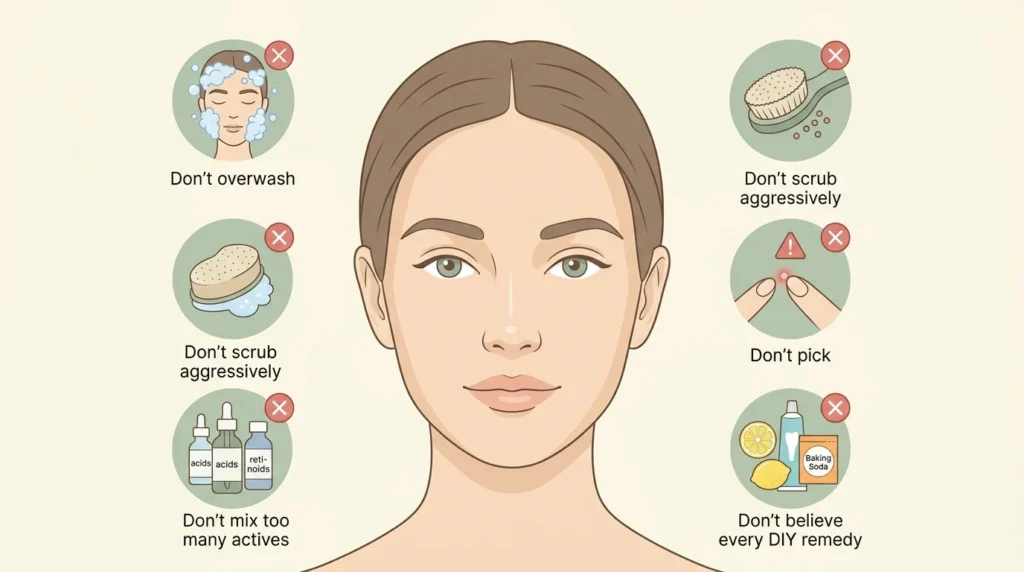
Don’t Mix Too Many Actives
Using multiple strong acne treatments at once can damage the skin barrier and make irritation more likely.
Don’t Pick
Picking can increase inflammation and contribute to post-acne marks and scars.
Don’t Believe Every DIY Remedy
Natural doesn’t automatically mean safe. Lemon juice, vinegar, toothpaste, and baking soda can irritate facial skin.
A Simple Routine to Prevent Breakouts
You don’t need a complicated 10-step routine.
Morning ☀️
Step 1: Gentle cleanser
Step 2: Suitable acne treatment, if needed
Step 3: Non-comedogenic moisturizer
Step 4: Broad-spectrum SPF 30+ sunscreen
Evening 🌙
Step 1: Gentle cleanser
Step 2: Appropriate acne treatment
Step 3: Moisturizer
Introduce new treatments gradually. Most acne treatments need consistent use over several weeks before you can fairly judge whether they are helping.
If your skin becomes very dry, painful, or irritated, reduce irritating products and speak with a healthcare professional if the problem continues.
When Should You See a Dermatologist?
Home care may not be enough when:
- Acne is deep or painful
- Breakouts are widespread
- Pimples keep returning
- Acne is leaving scars
- Dark marks are becoming extensive
- OTC treatment hasn’t helped
- Acne is affecting your confidence or emotional wellbeing
- You’re not sure whether the bumps are acne
Getting appropriate treatment early can help control acne and reduce the risk of lasting scars.
Frequently Asked Questions
How can I stop my face from breaking out?
Use a simple, consistent routine with gentle cleansing, appropriate acne treatment, moisturizer, and sunscreen. Avoid picking, harsh scrubbing, and products that clog or irritate your skin.
How can I stop breakouts before they start?
Identify your personal triggers, keep your skincare routine consistent, cleanse after heavy sweating, use non-comedogenic products, avoid picking, and treat acne early rather than waiting for breakouts to become severe.
How can I stop breakouts on my chin?
Keep the area clean, avoid touching it, use appropriate acne treatment, and pay attention to hormonal patterns. Persistent deep chin acne may need professional treatment.
How can I stop breakouts after shaving?
Use a clean, sharp razor, shave gently with lubrication, avoid repeatedly going over the same area, and don’t pick bumps afterward. If the bumps keep returning, they may be razor bumps or folliculitis rather than acne.
How can I stop breakouts after waxing?
Keep the skin clean, avoid unnecessary touching, and don’t use harsh exfoliants immediately after waxing. If you repeatedly develop bumps after waxing, consult a dermatologist.
Can I remove pimples overnight?
There is no reliable way to completely remove an acne pimple overnight. You can reduce irritation and swelling while allowing the lesion to heal.
Can I get rid of pimples permanently?
Acne can often be controlled successfully, but there is no guaranteed permanent cure. Hormones, genetics, and other factors can cause acne to return.
Why am I breaking out so easily?
Frequent breakouts may be related to hormones, genetics, oil production, clogged pores, irritating products, friction, stress, or medications. A dermatologist can help determine possible causes when acne is persistent.
Final Thoughts
Learning how to stop breakouts is less about finding a miracle cure and more about understanding what your skin needs.
Keep your routine simple, cleanse gently, use suitable acne treatments, moisturize, protect your skin from the sun, and avoid picking. If your breakouts appear after shaving, waxing, wearing a mask, or around your period, identifying these patterns can help you manage them more effectively.
Remember that healthy skin doesn’t have to be perfectly clear. Occasional pimples are normal, and having acne doesn’t mean you’ve done something wrong. 🌿
If your breakouts are deep, painful, persistent, or leaving scars, don’t keep trying increasingly harsh home remedies. A dermatologist can help you find an appropriate treatment plan and reduce the chance of lasting skin changes.
Medical note: This article is for general educational purposes and does not replace professional medical advice. Severe, painful, persistent, or scarring acne should be evaluated by a dermatologist or qualified healthcare professional.
Hannah Collins is a skincare writer focused on simple routines, trusted ingredient research, and practical advice for healthy, glowing skin.