
If your face becomes shiny a few hours after washing, you may wonder why you need moisturizer at all. For many teenagers, oily skin makes moisturizer seem unnecessary—or even like something that could cause more pimples.
But oily skin still needs hydration. The trick is choosing a moisturizer with a comfortable texture and ingredients that suit your skin rather than using a thick product that feels greasy.
The right moisturizer for oily skin teens should provide lightweight hydration, support the skin barrier, and fit easily into your daily routine. In this guide, you’ll learn what to look for, which ingredients may be useful, whether you need SPF, and how to choose a moisturizer for oily, acne-prone, or sensitive teenage skin.
Do Teens With Oily Skin Need Moisturizer?
Yes. Having oily skin doesn’t mean your skin cannot become dry, dehydrated, or irritated.
During puberty, hormonal changes can increase sebum production, making teenage skin look shiny. At the same time, cleansing, acne treatments, weather, or other skincare products can leave the skin feeling tight or uncomfortable.
A suitable moisturizer helps provide hydration and supports the skin’s protective barrier. The goal isn’t to remove every trace of oil. Instead, choose a formula that gives your skin the hydration it needs without feeling unnecessarily heavy.
What Is the Best Moisturizer for Oily Skin Teens?
There isn’t one moisturizer that is automatically best for every teenager. The best moisturizer for oily skin teens is one that matches their skin type, sensitivity, and other concerns.
For many teenagers with oily skin, useful features include:
- A lightweight gel, lotion, or gel-cream texture
- A non-comedogenic formulation
- Hydrating ingredients such as glycerin or hyaluronic acid
- Barrier-supporting ingredients such as ceramides
- Fragrance-free options for easily irritated skin
- SPF in a daytime product if you prefer combining moisturizing and sun protection
You don’t need an expensive product or one specifically marketed as a “teen moisturizer.” The formulation, texture, and way your skin responds are more important than the marketing.
What Type of Moisturizer Works Well for Oily Teenage Skin?
The texture of a moisturizer can make a big difference in how comfortable it feels.
Gel Moisturizer
Gel formulas are usually lightweight and can feel refreshing on oily skin. They’re a popular choice for teenagers who dislike the heavy feeling of traditional creams.
Lightweight Lotion
A light lotion can provide everyday hydration without feeling excessively rich. This may work well if your skin is oily but still feels tight after cleansing.
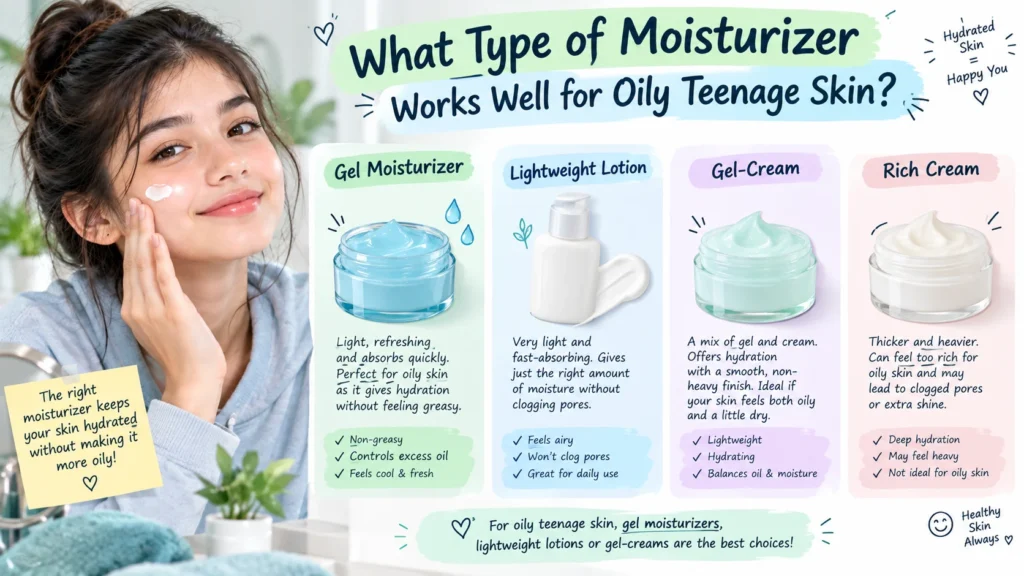
Gel-Cream
Gel-creams offer a middle ground. They can provide more cushioning than a very light gel while still feeling relatively comfortable on oily skin.
Rich Cream
A rich cream isn’t automatically unsuitable for oily skin. However, if it leaves your face feeling excessively greasy or uncomfortable, a lighter texture may be a better match.
Your skin’s needs can also change with weather and seasons, so you don’t necessarily need to use the exact same texture all year.
Which Ingredients Should You Look For?
You don’t need a moisturizer packed with dozens of ingredients. A few well-established hydrating and barrier-supporting ingredients can be enough.
Ceramides
Ceramides are lipids naturally found in the skin. They help support the skin’s protective barrier and are commonly included in moisturizers designed for barrier care.
They can be particularly useful if your skin feels dry, tight, or irritated even though it becomes oily during the day.
Hyaluronic Acid
Hyaluronic acid is a humectant that helps attract and retain water. It is commonly used in lightweight moisturizers and can provide hydration without requiring a heavy, oily texture.
Glycerin
Glycerin is another common humectant used in moisturizers. It helps draw water into the outer layers of the skin and is found in many everyday skincare formulas.
Niacinamide
Niacinamide, or vitamin B3, is widely used in skincare and can be found in moisturizers formulated for different skin types.
You don’t need to look for an extremely high concentration. A simple moisturizer containing niacinamide can be enough if your skin tolerates it well.
What Is a Good Moisturizer for Oily Acne-Prone Teenage Skin?
If you’re dealing with both oiliness and acne, look for a moisturizer that feels lightweight and is preferably labeled non-comedogenic.
This can be especially useful if your routine includes acne treatments that make your skin feel dry or irritated.
A simple routine might look like:
Morning:
Gentle cleanser → moisturizer → sunscreen
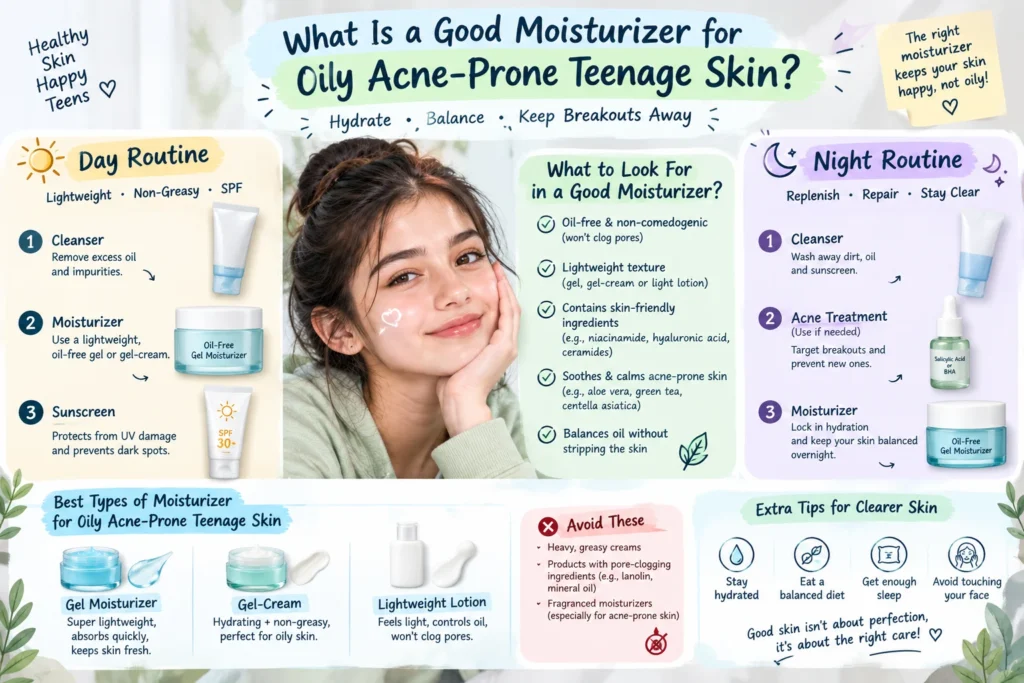
Night:
Gentle cleanser → acne treatment if needed → moisturizer
You don’t need to add multiple acne products simply because your skin is oily. Introducing several active ingredients at once can increase irritation and make it harder to determine which products are helping.
What About a Moisturizer for Oily Skin Teens With SPF?
A moisturizer for oily skin teens with SPF can be a convenient daytime option because it combines hydration and sun protection in one product.
If you choose this type of product, look for broad-spectrum SPF and follow the label instructions carefully. A lightweight formula may be more comfortable if your skin becomes shiny easily.
However, moisturizer with SPF isn’t your only option. You can also use a regular moisturizer followed by a separate broad-spectrum sunscreen.
For regular daytime sun exposure, SPF 30 or higher is commonly recommended. For longer outdoor activities, reapplication and other sun-protective measures such as shade, hats, and protective clothing can also be important.
Does an SPF Moisturizer Replace Sunscreen?
It can provide sun protection when it is properly formulated and applied according to its directions, but the amount you apply matters.
If you apply only a tiny amount because you’re worried about looking greasy, you may not receive the protection indicated on the label.
For significant outdoor exposure, a dedicated sunscreen may be easier to apply in an adequate amount and reapply as needed.
Best Face Moisturizer for a Teenage Girl
There isn’t one universal best face moisturizer for teenage girl skin.
Teenage girls can have oily, dry, combination, acne-prone, or sensitive skin. Even two people with oily skin may prefer completely different textures.
When choosing a moisturizer, consider:
- Whether your skin is oily, dry, or combination
- Whether you experience pimples or clogged pores
- Whether your skin is sensitive
- Whether you prefer gel, lotion, or cream
- Whether you want SPF in your daytime moisturizer
For an oily teenage girl, a lightweight gel, lotion, or gel-cream can be a practical starting point.
Best Moisturizer for Teenage Girl in Pakistan
If you’re searching for the best moisturizer for teenage girl in Pakistan, your skin type should still come first.
Pakistan’s weather varies considerably, and hot or humid conditions can make a rich moisturizer feel uncomfortable. During warmer weather, a lightweight gel or lotion may feel easier to wear.
During cooler or drier weather, however, you may prefer a slightly more moisturizing texture.
If your skin is acne-prone or sensitive, don’t choose a product just because it’s popular. Check the formulation, introduce new products gradually, and pay attention to how your skin reacts.
Best Moisturizer for Teen Boys Face
The best moisturizer for teen boys face doesn’t need to be different simply because the user is male.
Teen boys can have oily, dry, combination, acne-prone, or sensitive skin just like teen girls. Puberty can also increase oil production.
For oily teenage skin, look for a moisturizer that:
- Feels lightweight
- Doesn’t leave an uncomfortable greasy film
- Suits your skin concerns
- Is preferably non-comedogenic if you’re prone to clogged pores
- Provides enough hydration to keep your skin comfortable
There’s no need to choose a product based solely on “men’s” or “boys'” marketing.
Best Moisturizer for Teenage Girl With Sensitive Skin
If you’re searching for the best moisturizer for teenage girl sensitive skin, simplicity is often a useful starting point.
Sensitive skin may react to certain fragrances, ingredients, or complicated formulas. A gentle, fragrance-free moisturizer can be worth considering if your skin is easily irritated.
Pay attention to symptoms such as:
- Burning
- Persistent stinging
- Itching
- Significant redness
- New irritation after application
If a product repeatedly causes discomfort, stop using it rather than continuing to apply it in the hope that your skin will eventually adjust.
For ongoing or significant irritation, a dermatologist or other qualified healthcare professional can help identify possible causes.
Can Oily and Sensitive Skin Use the Same Moisturizer?
Yes. Oily and sensitive skin can occur together.
You might have visible shine on your forehead and nose while also experiencing redness, tightness, or irritation.
If this sounds familiar, avoid assuming that stronger products are automatically better. A gentle cleanser and lightweight moisturizer may be a better foundation than repeatedly washing your face or using harsh products to remove oil.
Choose a formula that feels comfortable and introduce new products one at a time when possible.
Can Moisturizer Cause Pimples?
Moisturizer itself doesn’t automatically cause pimples.
However, a particular product may not suit your skin. A formula that feels too heavy, irritating, or otherwise unsuitable may contribute to problems for some individuals.
If you notice breakouts after starting a new moisturizer, consider:
- Whether you’ve introduced any other new products.
- Whether the moisturizer feels excessively heavy.
- Whether you’re applying more than you need.
- Whether the formula is appropriate for your skin concerns.
- Whether the reaction could actually be irritation rather than acne.
Introducing one new product at a time makes it easier to understand how your skin responds.
How Much Moisturizer Should a Teen Use?
You don’t need to apply a thick layer of moisturizer.
Use enough to spread a comfortable, even layer over your face. The exact amount can vary depending on the product’s texture and directions.
If your skin still feels tight afterward, you may need more hydration. If your face immediately feels excessively greasy, you may be applying too much or the formula may simply be too rich for your skin.
The goal is comfortable hydration—not a thick coating.
How to Apply Moisturizer Correctly
Using moisturizer doesn’t need to be complicated.
Step 1: Cleanse Gently
Wash your face with a gentle cleanser suitable for your skin.
Avoid aggressive scrubbing. Oily or acne-prone skin doesn’t need to be rubbed repeatedly to become clean.
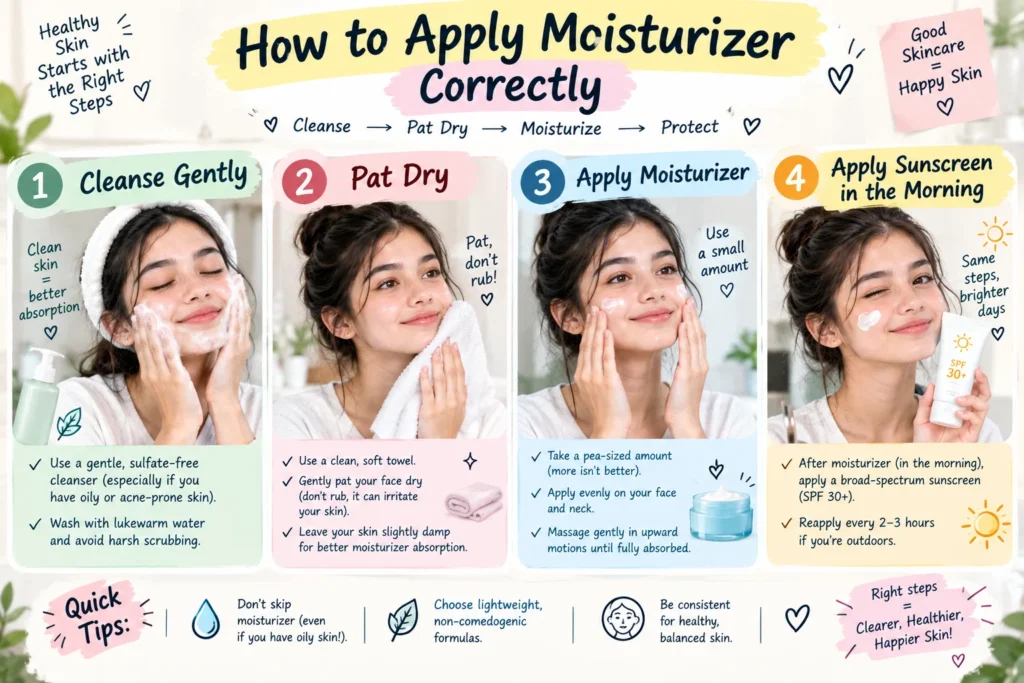
Step 2: Pat Dry
Use a clean towel and gently pat your face rather than rubbing it vigorously.
Step 3: Apply Moisturizer
Spread a suitable amount evenly over your face. Some moisturizers can be applied while the skin is slightly damp, depending on the product and your preference.
Step 4: Apply Sunscreen in the Morning
If your moisturizer doesn’t provide adequate broad-spectrum SPF, apply sunscreen as the final skincare step before daytime outdoor exposure.
At night, finish your routine with your moisturizer.
What Is the Best Natural Moisturizer for Teenage Skin?
If you’re searching for the best natural moisturizer for teenage skin, remember that “natural” doesn’t automatically mean safer, gentler, or more effective.
Plant-based ingredients can still irritate some people or cause allergic reactions. A properly formulated moisturizer can be a more predictable option than experimenting with homemade mixtures.
Instead of choosing a product solely because it says “natural,” consider its complete ingredient list, texture, and how your skin responds.
Are Homemade Moisturizers Safe for Teenagers?
Not necessarily.
Kitchen ingredients are not automatically suitable for facial skin. Lemon juice, baking soda, sugar scrubs, and undiluted essential oils are examples of DIY ingredients that can cause irritation or other skin problems.
If you prefer a simpler or more naturally positioned skincare routine, a properly formulated product is generally a more practical choice than mixing random ingredients at home.
Moisturizer for Oily Skin Teens in Pakistan: What Should You Consider?
When choosing a moisturizer for oily skin teens in Pakistan, consider more than the product’s popularity.
Think about:
| What to Consider | Why It Matters |
|---|---|
| Lightweight texture | May feel more comfortable on oily skin |
| Non-comedogenic formula | Useful if you’re prone to clogged pores |
| Humectants | Help provide hydration |
| Ceramides | Support the skin’s protective barrier |
| Fragrance-free option | Worth considering if your skin is sensitive |
| SPF for daytime | Can combine moisturizing and sun protection |
| Weather | A lighter texture may feel better in hot or humid conditions |
Your ideal moisturizer may also change with the seasons.
Simple Morning Routine for Oily Teenage Skin
You don’t need a complicated morning routine.
1. Gentle Cleanser
Clean your face without aggressive scrubbing.
2. Lightweight Moisturizer
Apply a moisturizer that suits your skin type and feels comfortable.
3. Sunscreen
Use broad-spectrum sunscreen during the daytime according to the product’s directions.
If you use a moisturizer with SPF, make sure you apply it as directed rather than using only a very small amount.
Simple Night Routine for Oily Teenage Skin
Your nighttime routine can be even simpler:
Cleanser → acne treatment if needed → moisturizer
If you’re using an acne treatment, follow the product directions. Some treatments can cause dryness or irritation, so adding several strong products at the same time isn’t always a good idea.
A nighttime moisturizer doesn’t need SPF.
Common Moisturizer Mistakes Teenagers Make
Skipping Moisturizer Because Your Skin Is Oily
Oiliness doesn’t mean your skin cannot need hydration.
Choosing the Heaviest Cream
A richer formula isn’t automatically better. If it feels greasy or uncomfortable, try a lighter texture.
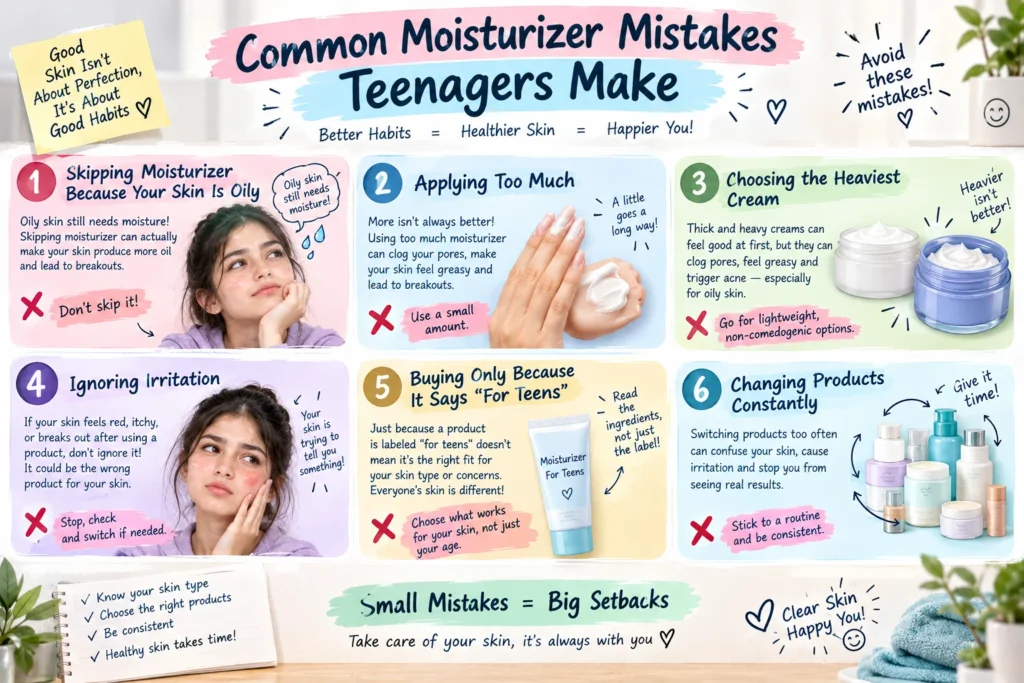
Applying Too Much
A thick layer isn’t necessarily more effective. Start with an appropriate amount and adjust based on your skin and the product directions.
Changing Products Constantly
Using a different moisturizer every few days makes it difficult to understand which products your skin tolerates.
Ignoring Irritation
Persistent burning, stinging, itching, or redness isn’t something you should simply ignore because a product is marketed for oily skin.
Buying Only Because It Says “For Teens”
Teen-specific marketing doesn’t guarantee that a moisturizer will suit your skin. Your skin type and concerns are more important.
How to Build a Simple Teen Skincare Routine
If you’re new to skincare, start with the basics.
Morning
Gentle cleanser → moisturizer → broad-spectrum sunscreen
Night
Gentle cleanser → acne treatment if needed → moisturizer
You can add other products later if you have a specific reason to use them. Starting simple makes it easier to understand what your skin actually needs.
When Should a Teenager See a Dermatologist?
Moisturizer can support your skincare routine, but it isn’t a treatment for moderate or severe acne by itself.
Consider professional advice if you have:
- Deep or painful acne
- Nodules or cysts
- Acne that is leaving scars
- Persistent breakouts that aren’t improving
- Significant irritation from skincare products
- Skin problems that are affecting your confidence or daily life
A dermatologist can assess your skin and recommend an appropriate treatment rather than having you continually switch between products.
FAQs About Moisturizer for Oily Skin Teens
Can teenagers with oily skin use moisturizer every day?
Yes. A suitable moisturizer can be part of a daily routine. Choose a texture that feels comfortable and provides enough hydration without feeling excessively heavy.
What is the best moisturizer for oily skin teens?
There isn’t one universal best moisturizer. A lightweight, non-comedogenic formula with hydrating ingredients such as glycerin, hyaluronic acid, or ceramides can be a useful starting point.
Is gel moisturizer better for oily teenage skin?
Gel moisturizer can be a comfortable choice because it often has a lightweight texture, but it isn’t automatically better than every lotion or gel-cream. Choose the texture that suits your skin and preferences.
Should oily skin teens use moisturizer at night?
Yes. A lightweight nighttime moisturizer can help keep skin comfortable and support the skin barrier, especially if your routine includes products that cause dryness.
Can I use moisturizer if I have acne?
Yes. Acne-prone skin can still need hydration. Look for a suitable lightweight or non-comedogenic formula and introduce new products gradually.
Is moisturizer with SPF enough for teenagers?
A moisturizer containing broad-spectrum SPF can combine two steps, provided it is applied according to the product’s directions. For prolonged outdoor exposure, a dedicated sunscreen may be easier to apply and reapply adequately.
What is the best moisturizer for sensitive teenage skin?
Look for a simple, gentle formula that doesn’t cause persistent burning, stinging, itching, or redness. A fragrance-free option may be worth considering if your skin is easily irritated.
Can boys and girls use the same moisturizer?
Yes. Moisturizer doesn’t need to be selected based on gender. Skin type, sensitivity, acne concerns, texture preference, and environment are more useful factors.
Should I use a natural moisturizer as a teenager?
You can choose a product with naturally derived ingredients if it suits your skin, but “natural” doesn’t automatically mean safer. A properly formulated moisturizer is generally a better choice than experimenting with homemade facial mixtures.
Quick Guide to Choosing a Moisturizer
Still unsure what to choose?
Oily skin:
Try a lightweight gel, lotion, or gel-cream.
Oily and acne-prone skin:
Consider a lightweight, non-comedogenic formula.
Oily and sensitive skin:
Look for a simple, gentle moisturizer and consider fragrance-free options.
Oily but dry or irritated:
Consider a moisturizer with barrier-supporting ingredients such as ceramides and reduce unnecessary harsh skincare.
Oily skin with daytime outdoor exposure:
Choose a moisturizer that works comfortably with broad-spectrum sunscreen, or use a suitable moisturizer containing SPF.
Final Thoughts
Finding the right moisturizer for oily skin teens doesn’t have to be complicated. Oily skin still needs hydration, and completely avoiding moisturizer isn’t necessary just because your face becomes shiny.
Start with a lightweight formula that suits your skin. Look for useful features such as a comfortable texture, non-comedogenic formulation, and hydrating ingredients like glycerin, hyaluronic acid, or ceramides. If your skin is sensitive, keeping the formula simple can make your routine easier to manage.
For teenagers in Pakistan, weather and outdoor exposure can also influence which texture feels comfortable. A lightweight gel or lotion may be preferable during hot weather, while a more moisturizing formula may feel better when the weather is cooler or your skin becomes dry.
Most importantly, don’t choose a moisturizer simply because it is trending or marketed specifically for teenagers. Your skin type, sensitivity, acne concerns, and personal comfort matter more than the label.
A simple routine—gentle cleansing, appropriate moisturizing, and daytime sun protection—is often a better starting point than a shelf full of products. 🌿

Emma Brooks is a skincare writer who creates simple, research-based skincare guides, ingredient insights, and practical routines for healthy skin.